Are solar panels worth it in Arizona? Usually yes, but less than the sunshine suggests. A typical system on a new one-story home in Phoenix or Tucson pays for itself in roughly 13 to 19 years. Arizona utilities pay little for the power you send back to the grid, and some solar rate plans add demand charges. In Colorado the sun is weaker, but net metering still credits exports close to the retail price, so payback on the Front Range is often similar or a little faster. Either way, the numbers get much better when you design the house and the roof for solar from day one instead of adding panels later.
This breakdown uses 2026 prices and a 2,000 sq ft all-electric one-story home built to the current energy code. Treat every figure as a range. Rates and buyback credits change every year or two, and they decide most of the result. Before you sign anything, check the current tariff with your utility and get at least two local quotes.
What a Solar System Costs on a New Home in 2026
Here is a typical 7 to 8 kW system, the size that covers most of the yearly use of a 2,000 sq ft home in the Southwest. Installing it during construction is usually cheaper than a retrofit, because conduit, the main panel and roof attachments go in while the walls and roof are open.
| Cost item | Typical range (USD, 2026) | Notes |
|---|---|---|
| Panels (7–8 kW) | $4,000 – $7,000 | Higher-efficiency modules cost more per watt |
| Inverter or microinverters | $2,500 – $5,000 | Microinverters help with partial shade from parapets |
| Racking, pitched roof | $1,500 – $3,000 | Flush mounts on asphalt shingle or metal |
| Racking, flat or low-slope roof | $2,500 – $5,000 | Tilted frames, ballast or anchored attachments |
| Electrical work and labor | $5,000 – $9,000 | Wiring, disconnects, monitoring |
| Design, permit, interconnection | $500 – $2,000 | City or county permit plus utility approval |
| Main panel upgrade (if needed) | $0 – $3,000 | Often avoidable if a 200A or larger panel is specified early |
| Home battery (10–13 kWh) | $10,000 – $16,000 | Optional; most useful under demand and time-of-use rates |
| Total without battery | $18,000 – $26,000 | About $2.50 – $3.30 per watt |
One change matters a lot. The 30% federal tax credit for homeowner-owned residential systems ended for systems installed after 2025. The figures below assume no federal credit. Ask your installer and tax advisor what state, utility or third-party ownership incentives are still available where you build.
Are Solar Panels Worth It in Arizona? Savings in Numbers
The table compares yearly electric bills with and without solar for the same house in three cities. Assumptions: 2026 rates, a heat pump for heating and cooling, LED lighting, an electric water heater, and electricity prices rising about 2.5% a year for the 10- and 20-year totals. Phoenix uses the most power because of air conditioning from May to October.
| Phoenix | Tucson | Denver | |
|---|---|---|---|
| Yearly use, kWh | 14,000 – 16,000 | 12,500 – 14,500 | 9,500 – 11,500 |
| Yearly bill without solar | $2,200 – $2,800 | $1,900 – $2,400 | $1,600 – $2,100 |
| System size | 8 kW | 7.5 kW | 7 kW |
| Yearly bill with solar | $900 – $1,500 | $800 – $1,300 | $300 – $700 |
| Added cost of the system | $20,000 – $25,000 | $18,000 – $23,000 | $19,000 – $24,000 |
| Savings over 10 years | $11,000 – $15,500 | $10,000 – $14,500 | $13,000 – $17,000 |
| Savings over 20 years | $25,000 – $35,000 | $23,000 – $33,000 | $30,000 – $38,000 |
| Payback period | 13 – 19 years | 13 – 19 years | 12 – 17 years |
Why does Denver keep up with Phoenix despite less sun? In Arizona, the big utilities moved away from full net metering years ago. APS and Tucson Electric Power credit exported power at an export rate that has been stepping down. In recent years it has typically been well under half of what you pay for a kilowatt-hour from the grid. SRP, which serves much of the Phoenix metro, has long put solar customers on rate plans with a demand charge. That charge is based on your highest hour of use during peak time, so one evening of running the AC, the oven and the dryer together can wipe out part of a month's savings. Panels produce plenty at noon, but much of that power is exported cheaply while the evening peak is still billed.
So are solar panels worth it in Colorado? For most new homes on the Front Range, yes. State law has kept net metering, and Xcel Energy credits exports at roughly the retail rate. The trade-off is that the system is usually limited to about the home's expected yearly use. In practice, what you send out in June comes back almost one for one in January.
Time-of-use rates and why west-facing panels can win
Most solar customers in both states end up on time-of-use pricing, where power costs the most on late afternoons and evenings. A south-facing array produces the most kilowatt-hours over a year. A west-facing array produces perhaps 10 to 20% less, but more of it arrives between about 3 and 7 p.m., when the AC runs hardest and grid power is most expensive. Under Arizona export rates and demand charges, a southwest or west orientation often saves more money than a due-south one. Ask your installer to model both against your actual tariff, not just total output.
The same logic explains batteries in Arizona. A battery stores cheap midday power and covers the evening peak, which lowers both the energy charge and the demand charge. It adds $10,000 or more, so it rarely shortens the payback on its own. It does make the system work much better on a demand plan, and it keeps the lights and the fridge running during an outage.
Flat and Low-Slope Roofs on Southwestern Plans
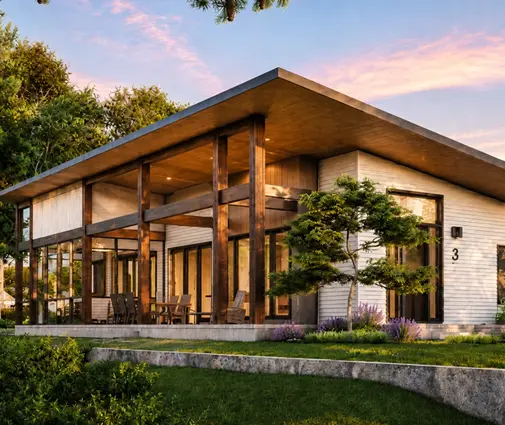
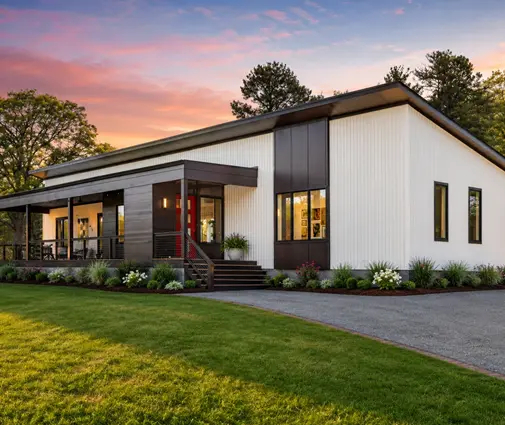
Desert modern homes often use flat or very low-slope roofs behind a parapet, frequently with spray foam or a single-ply membrane. Panels lying flat lose output and collect dust, so installers put them on tilted frames, usually at 10 to 20 degrees. The frames are held down by ballast blocks, anchored to the structure, or both. Three things to settle while the plan is being adapted:
- Structure. Ballasted racks add dead load, and the roof framing has to carry it plus the wind uplift for your area. Your engineer should size the joists or trusses for it.
- Parapet shade. A tall parapet throws a shadow on the first row of panels in winter. Keep rows back from the edge, or use microinverters so one shaded panel does not drag down the rest.
- Roofing. Every penetration in a foam or membrane roof is a future leak point. Plan flashed curbs and a conduit chase before the roofer starts.
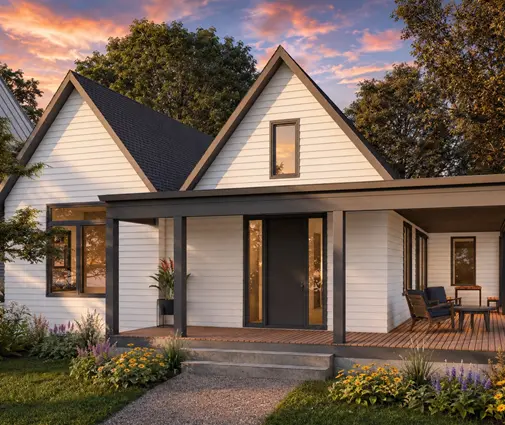
A plan like this mid-century modern one-story with three bedrooms keeps a compact, simple footprint that leaves a clean roof field for rows of panels. The four-bedroom modern ranch of 2,112 sq ft offers a broad roof over a single level, close to the size of the house in our tables. You can browse more homes with low, flat rooflines suited to tilted solar racks.
Hail and Snow on Front Range Roofs
The stretch from Fort Collins to Colorado Springs is one of the most hail-prone areas in the country. Standard panels pass a certification test with ice balls about an inch across, and some carry higher impact ratings. In hail country, choose panels with the stronger rating. Confirm that your homeowner's policy covers the array, and ask how the deductible works after a storm. Many Colorado insurers already set separate wind and hail deductibles.
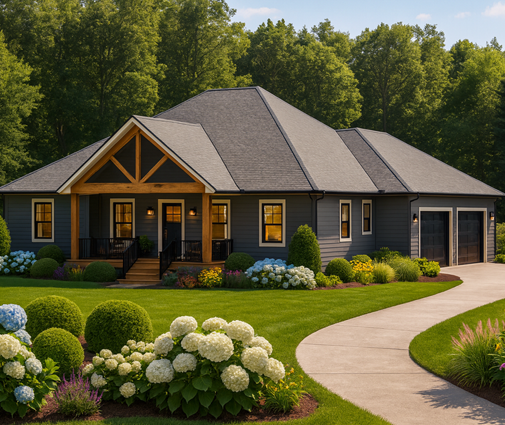
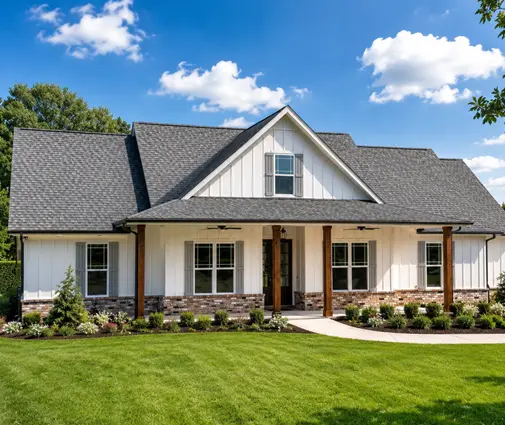
Snow is less of a problem than people expect. On a 6:12 or steeper roof, panels warm up in the sun and snow slides off within a day or two. The real issue is where that snow lands, so add snow guards above entries and walkways. A Craftsman such as this 1,972 sq ft one-story with a south-facing gable option or a mountain home like this large Craftsman with a walkout basement gives you the pitched roof planes that suit Colorado arrays. For smaller budgets, the three-bedroom modern farmhouse of 1,993 sq ft keeps its main roof simple and easy to cover with panels.
How to Save on Solar in a New Build
The cheapest kilowatt-hour is the one the house never uses. The IRC energy provisions, based on the IECC, already require a tight envelope. Going further pays off in both states. The Passive House approach, along with programs like Energy Star and the DOE Zero Energy Ready Home, aims at very low heating and cooling loads, which means a smaller and cheaper array. Measures that shrink the system you need:
- Insulation and a reflective roof. In Phoenix, keeping heat out of the attic or roof deck cuts AC load more than any other single step.
- Low-solar-gain windows and deep overhangs on west walls, so less afternoon sun gets in.
- Airtightness, verified with a blower-door test, which keeps cooled or heated air inside.
- An efficient heat pump for heating and cooling, plus a heat pump water heater.
- Ventilation with heat or energy recovery, which brings in fresh air while keeping most of the conditioned air's temperature.
Other ways to save: prewire during framing, specify a large enough main panel from the start, size the system to your real use rather than to the roof's full capacity, and in Arizona, stagger big loads such as the dryer or EV charger outside peak hours. A compact plan helps too. The 2,951 sq ft single-level farmhouse needs a noticeably bigger array than a home under 2,000 sq ft. Your local designer can adapt any stock plan to your lot's orientation, so the best roof plane faces south or west.
The Short Version
- In Arizona, solar usually pays back in about 13 to 19 years, because export credits are low and some plans add demand charges.
- In Colorado, net metering keeps exports close to retail value, so payback is often 12 to 17 years despite less sun.
- The federal credit for owner-purchased home systems ended after 2025. Check state and utility incentives before you buy.
- West or southwest panels often save more money than south-facing ones under time-of-use pricing.
- A battery makes the most sense on Arizona demand and time-of-use plans, or if you want backup power.
- Flat roofs need tilted racks, framing sized for the extra load, and careful flashing. Front Range roofs need hail-rated panels and snow guards.
- Cut the load first with insulation, good windows and airtightness, then size the array. When you are ready to compare designs, start with homes in our flat roof plan collection or browse one-story house plans.