Are solar panels worth it in Ohio? For a new home, often yes, but only modestly. With power at roughly 15 to 17 cents per kWh in 2025, no federal tax credit for owner-bought systems installed after 2025, and exports usually credited below the retail price, a well-sited array in Ohio pays for itself in about 15 to 20 years. It lasts 25 to 30. The deal improves when you design the house around the panels from the start instead of adding them later. The steps below show how to judge your own state and lot, and what to put into the plans before the framing crew shows up.
Step 1: Check whether solar panels are worth it in Ohio or your state
Two numbers decide most of the answer: how many kWh one kilowatt of panels makes in a year where you live, and what you pay per kWh. Free production estimates from national solar calculators give the first number for your address. Your utility bill gives the second. Typical 2025 ranges for a south-facing roof without shade:
- Ohio: about 1,150 to 1,300 kWh per kW. Production is decent, but the payback is long because rates are average and exports earn less.
- Illinois: about 1,200 to 1,300 kWh per kW. Are solar panels worth it in Illinois? Usually more than in Ohio, because the state incentive described in Step 2 cuts the upfront cost.
- Kansas: about 1,400 to 1,550 kWh per kW, the best sun in this group. Moderate rates keep it a fair, not great, investment.
- Kentucky: about 1,250 to 1,350 kWh per kW. Some of the cheapest power in the region makes Kentucky the weakest case. It is worth it mainly if you value backup power or expect rates to rise.
- South Dakota: about 1,350 to 1,450 kWh per kW. The sun is strong, but low rates and thin export credits mean you should size the array to your own use.
- Alaska: roughly 800 to 950 kWh per kW in the Railbelt. December production is close to zero. Even so, electricity often costs 23 cents or more, so panels can be worth it in Alaska, and in diesel-powered rural towns they pay off faster still.
Step 2: Read your utility's export rule before anything else
Net metering decides what happens to the power you don't use at the moment it's made. Rules change often, so read the current tariff of your utility or co-op. A short call takes about an hour and costs nothing.
In Ohio, investor-owned utilities generally credit exports at something close to the supply part of the rate, and co-ops write their own terms. Illinois credits exports for new customers at the supply portion. In exchange, the state's Illinois Shines program pays upfront for the renewable energy credits a system will produce over many years, and in good blocks that can cover a meaningful share of the install. Kentucky lets utilities set export credits well below retail for new systems. South Dakota has no statewide net metering mandate, and exports often earn only an avoided-cost rate. Alaska's larger utilities offer net metering, but surplus power is credited at a lower rate.
Are solar panels worth it in Kansas City? It depends on which side of State Line Road your lot sits. Missouri and Kansas have different net metering laws, even where the same utility serves both. The same check applies to states near Illinois. Indiana, for example, ended classic net metering for new systems in 2022.
Step 3: Size the array for July, not January
Midwest homeowners tend to judge solar by gray winter skies. The money is made in summer. A typical array in Columbus produces more in a single June than in December and January together, because a summer day there has about 15 hours of daylight and a high sun. Summer is also when air conditioning pushes your use and the utility's peak higher.
So size the system to cover most of your use from April through September. A larger array would mostly send cheap exports to the grid in May. For a 2,400 square foot home, that usually means 7 to 9 kW, about 18 to 24 modern panels, at roughly $2.50 to $3.25 per watt installed in 2025.
Step 4: Shrink the load before you buy panels
Every kWh you don't use is cheaper than a kWh you produce. The IECC energy code, which most Midwest jurisdictions adopt with their own amendments, sets the minimum. ENERGY STAR and the DOE Zero Energy Ready Home program go further. Passive house certification through PHIUS goes furthest: very thick insulation, triple-pane windows, and an airtight shell that cuts heating demand by more than half compared with a code-built house.
The upgrades that matter most in a cold climate:
- continuous exterior insulation over the 2x6 walls, which stops heat loss through the studs
- insulated basement walls and slab, so the lower floor isn't a heat sink all winter
- an airtight shell, tested with a blower door
- a cold-climate heat pump, which heats at two to three times the efficiency of resistance heat
- an energy recovery ventilator, which brings in fresh air while keeping most of the indoor heat
Budget $8,000 to $20,000 above code for this package. A lower load lets you buy a smaller array.
Step 5: Choose a plan whose roof can carry the panels
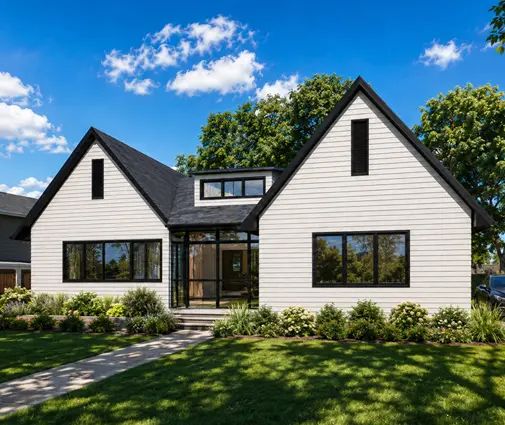
Look for a large, simple roof plane facing south, southwest or southeast, with few dormers, valleys or vent stacks. A one-story house has the most roof for its floor area. The single long ridge of this sprawling one-level ranch leaves room for a full array, and the single-story plans share that advantage.
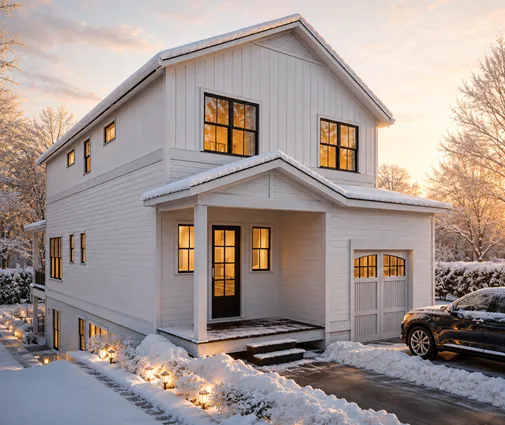
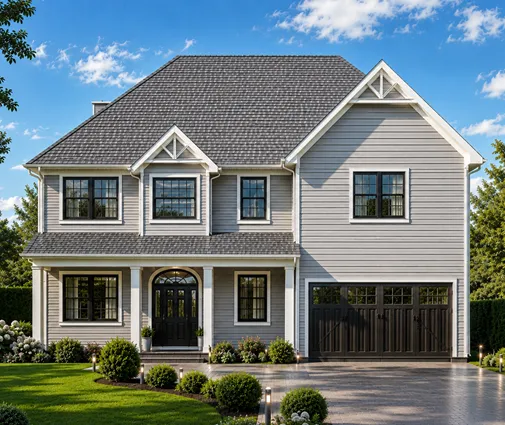
A tall house with a small footprint has less roof to work with. This narrow three-level Modern Farmhouse fits a city lot, but its roof can hold only a modest array, so pair it with the efficiency upgrades from Step 4. A five-bedroom Colonial stacked over three levels has the same limit. On larger homes, a big garage wing helps: this farmhouse with a three-bay garage offers a wide, low roof right beside the main panel.


When you browse house plans with a basement, check the roof plan and its orientation on your lot. A good front elevation tells you nothing about that.
Step 6: Plan the basement as the equipment room
A basement is the best place in a Midwest home for the inverter, the battery and the main electrical panel. It stays at 55 to 70°F all year, and lithium batteries last longer in that range. Plan these items during design:
- A conduit chase from the attic to the basement through an interior wall. It costs $200 to $600 during framing and far more to fish through finished drywall later.
- A 200-amp panel with free breaker space, or a busbar rated for a solar backfeed.
- Wall space of about 6 by 8 feet for a battery and inverter, raised off the floor and away from the sump pit.
- Code limits. The residential code limits where batteries can go and how much capacity is allowed indoors. Check placement and fire separation with your building department.
A battery adds $10,000 to $16,000 for roughly 10 to 15 kWh. Where export credits are low, it raises how much of your own power you use, and it keeps the furnace blower and sump pump running in an outage. This open contemporary one-story and a compact three-bedroom farmhouse both have full basements with room for a utility corner.
Step 7: Design for snow and ice
Ground snow loads across most of the Midwest fall roughly between 20 and 50 psf. Northern areas are higher, and parts of Alaska are much higher. Panels and racking add only about 3 to 4 psf, but the engineer adapting your stock plan should confirm that the rafters or trusses can carry both, along with drifting near the array.
Snow slides off glass faster than off shingles. Keep arrays away from roofs over entries and walkways, or add snow guards below them. Tilt helps too. A ground mount at 40 to 45 degrees sheds snow quickly and suits Alaskan acreage, but trenching adds $1,500 to $4,000.
Step 8: Run the numbers for your scenario
Assumptions: a new 2,400 square foot all-electric home with a heat pump, using about 14,000 kWh a year. Ohio power costs $0.16 per kWh with exports at about $0.08. Illinois power costs $0.17 with exports at about $0.09. The array is 8 kW, about 55% of its output is used in the home, prices are from 2025, rates are held flat, and there is no federal credit. The figures are estimates, not quotes.
| No solar | Ohio, 8 kW | Illinois, 8 kW with Illinois Shines | |
|---|---|---|---|
| Yearly electricity cost | $2,240 to $2,380 | about $1,000 to $1,150 | about $1,000 to $1,100 |
| Yearly savings | none | $1,100 to $1,300 | $1,250 to $1,400 |
| Extra cost when built in | none | $20,000 to $24,000 | $13,000 to $18,000 after incentive |
| Savings over 10 years | none | $11,000 to $13,000 | $12,500 to $14,000 |
| Savings over 20 years | none | $22,000 to $26,000 | $25,000 to $28,000 |
| Payback period | none | about 16 to 20 years | about 10 to 13 years |
If rates rise 2 to 3% a year, as they have in many recent years, payback shortens by a few years. In Kansas, use more kWh per kW. In Kentucky and South Dakota, use lower export credits.
Step 9: Permits, interconnection and the appraisal
Solar needs its own electrical permit and a signed interconnection agreement with the utility. Allow 3 to 8 weeks and $100 to $500 in fees. Ask your HOA early, since many restrict panel placement on street-facing roofs.
Lenders and appraisers value owned systems more readily than leased ones. Keep the production estimate and equipment specs for the appraisal file.

Timeline at a glance
| Step | When | Time needed | Typical cost (2025) |
|---|---|---|---|
| 1–2. Production, rates, export rules | Before buying the lot or plan | 1–2 days | Free |
| 3–4. Array size and envelope upgrades | Plan selection | 1–2 weeks | $8,000–$20,000 above code |
| 5. Plan and roof check | Plan selection | 1–3 weeks | Plan price |
| 6–7. Basement equipment room, snow load review | Plan adaptation by engineer or drafter | 2–4 weeks | $200–$600 chase; engineering fees vary |
| 8. Final numbers and installer bids | Before permit | 2–3 weeks | Free |
| 9. Permits and interconnection | During framing | 3–8 weeks | $100–$500 |
| Installation and inspection | After roofing, before move-in | 1–3 days plus inspection | $20,000–$26,000 for 8 kW |
Once you know your export rule and roof orientation, browse basement house plans with a clean south-facing roof and a lower floor ready for the equipment. Confirm current incentives and code requirements with your utility, your building department and the engineer who adapts the plan.