$18,771. That is the construction interest on a $450,000 two-story house built in 10 months at an 8.5% rate, if everything goes to schedule. Most owners guess either far less ("the first payments are only a few hundred dollars") or far more ("8.5% of $450,000 is $38,000 a year"). Both guesses are wrong for the same reason. A construction loan charges interest only on the money the lender has already released to your builder, so the monthly bill grows as the house goes up.
The steps below walk through the calculation with real-looking numbers. They also cover what a framing or permit delay costs and how to choose between an interest reserve and paying in cash. Rates and terms change and vary by lender. The figures here are an illustration for 2025–2026, not a quote, so plug in your own lender's numbers.
Step 1: Get the real draw schedule from your builder
Everything starts with the draw schedule. This is the list of construction stages and how much of the budget the lender releases at each one after an inspection: foundation, framing, dry-in, rough-ins, drywall, finishes, final. Ask your builder for it before you apply for the loan, not after closing.
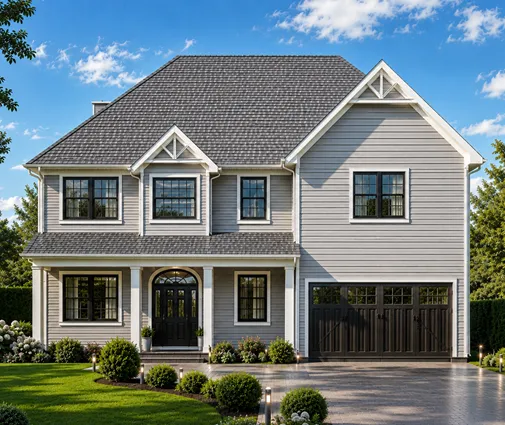
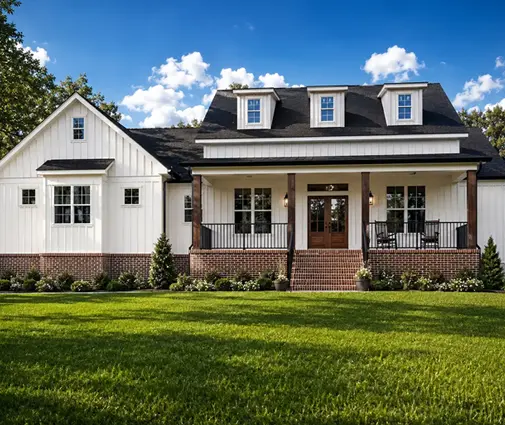
For the example, take a 2,500 sq ft two-story Modern Farmhouse like this 4-bedroom, 2-story farmhouse plan of 2505 sq ft with a 2-car garage. The build budget is $450,000, about $180 per sq ft. The lot is already owned, so the loan covers construction only.
Time: 1–2 weeks of back and forth with the builder. Cost: nothing, but a vague schedule makes every later number a guess.

Step 2: Pin down the rate and how interest is counted
Construction loans are usually variable and tied to the prime rate plus a margin. Ask the lender three questions:
- What is the margin over prime, and how often does the rate adjust?
- Is interest calculated on an actual/360 basis? Many commercial-style loans use it, and it adds roughly 1.4% to a year's interest compared with a 365-day count.
- Is interest charged from the date of each draw, or on the month-end balance?
The example uses 8.5% and simplifies to one draw at the start of each month, which gives a monthly rate of about 0.708%.
Time: one call. Cost: nothing.
Step 3: Build the month-by-month interest table
Multiply the outstanding balance by the monthly rate, month by month:
| Month | Stage | Draw | Balance | Interest that month |
|---|---|---|---|---|
| 1 | Site work, permits, footings | $45,000 | $45,000 | $319 |
| 2 | Foundation, slab or basement walls | $40,000 | $85,000 | $602 |
| 3 | Framing, first floor | $65,000 | $150,000 | $1,063 |
| 4 | Second floor, roof, windows | $55,000 | $205,000 | $1,452 |
| 5 | Plumbing, electrical, HVAC rough-ins | $50,000 | $255,000 | $1,806 |
| 6 | Insulation, drywall | $45,000 | $300,000 | $2,125 |
| 7 | Siding, interior trim | $45,000 | $345,000 | $2,444 |
| 8 | Cabinets, flooring | $45,000 | $390,000 | $2,763 |
| 9 | Fixtures, counters, paint | $35,000 | $425,000 | $3,010 |
| 10 | Final, driveway, landscaping | $25,000 | $450,000 | $3,188 |
| Total | $18,771 |
Two things stand out. The last three months cost almost half the total interest, $8,961 out of $18,771. And the full-balance guess of $3,188 a month for 10 months, or $31,875, overstates the bill by about $13,000.
The shape of the schedule matters. A 2-story farmhouse with a full basement (2170 sq ft, 4 bedrooms), typical in the North and Midwest, pulls more money in the first months for excavation and foundation walls, so interest builds earlier. A slab-on-grade Southern home such as this 2220 sq ft Acadian-style plan with 4 bedrooms starts lighter.
Step 4: Stress-test the schedule for delays
Delays rarely cut the work. They stretch the calendar, and you pay interest on whatever balance is sitting there while nothing happens. Three scenarios from the same example:
- Framing stalls for 2 months (lumber delivery, crew shortage, failed inspection) with $150,000 drawn: 2 × $1,063 = about $2,100 extra.
- A permit or plan-review delay of 2 months after closing, with a $100,000 lot rolled into the same loan: 2 × $708 = about $1,400 for an empty lot.
- Punch list and certificate of occupancy slip by 1 month at the full balance: about $3,200, the most expensive month of the project.
Beyond interest, check the loan term. Many construction loans run 12 months. Going past that can trigger an extension fee, often a fraction of a percent of the loan, or a re-approval. Add any rent or existing mortgage you are paying in the meantime. That is often the bigger number.
Time: an hour with a spreadsheet. Cost: plan for 2–3 months of extra interest in your contingency, roughly $5,000–$9,000 in this example.
Step 5: Decide between an interest reserve and paying in cash
With an interest reserve, the lender adds the estimated interest to the loan and pays each month's bill from it, so nothing leaves your bank account during the build. In the example the loan grows to about $470,000. Because the reserve is borrowed money, it accrues interest too. Here that is only about $400 over 10 months.
The catch is the loan limit. Lenders typically lend up to a share of the cost or the as-completed appraised value, often in the 75–85% range. A reserve raises the loan without raising the appraisal, so you may have to bring more cash at closing anyway. Also, a reserve sized for 10 months runs dry in month 11 if the build slips.
A practical rule:
- Use the reserve if you are paying rent or a current mortgage during the build. Two housing payments plus a climbing interest bill is how budgets crack.
- Pay in cash if you have steady income and a separate cash cushion. It saves the interest on interest and keeps the loan smaller for the appraisal.
Either way, keep the construction contingency, often 5–10% of the budget, separate from the interest money.
Step 6: Compare one-time close and two-time close loans
With a one-time close (construction-to-permanent) loan, you have one closing, one set of closing costs, and a permanent mortgage rate that is often locked at the start. During the build you still pay interest only on what has been drawn, so the table in Step 3 still applies. What changes is the rest of the math. You save a second round of closing costs, typically several thousand dollars, and you are protected if rates rise. If rates fall, you are locked in unless your lender offers a modification.
With a two-time close, a short construction loan is refinanced into a mortgage when the house is finished. You pay two sets of costs and qualify twice. In exchange, you can shop for the best mortgage rate at completion. Compare the total cost: construction interest, both sets of closing costs, rate-lock fees and the expected permanent rate.
Time: 1–2 weeks to collect loan estimates from two or three lenders. Cost: application or appraisal fees, often a few hundred dollars per lender.
Step 7: Cut the interest before you break ground
The cheapest month of interest is the one you never borrow for:
- Have permit-ready drawings before closing. A stock plan adapted by a local engineer or drafter to your lot, setbacks, HOA rules and local code amendments moves faster than a design started from scratch.
- Close after the permit is issued when the lender allows it, so no money sits idle during plan review.
- Freeze selections early. Change orders during finishes hit the months with the highest balance.
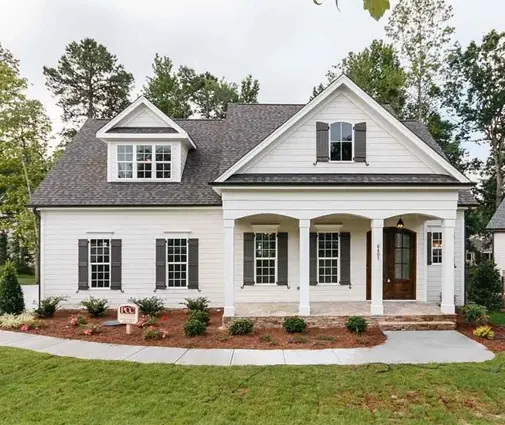
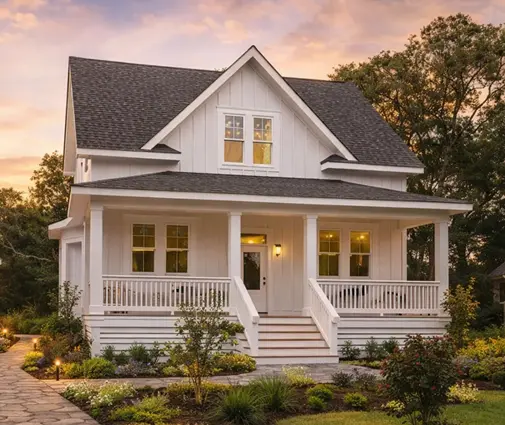
- Keep the scope realistic. A larger design like this 2879 sq ft cottage-style home with a 3-car garage means a bigger loan and usually a longer build. A plan like this 4-bedroom, 2-story farmhouse of 2472 sq ft without a garage trims both. You can browse more two-story house plans or narrow to the 2,500–3,000 sq ft range used in this example.
Step 8: Plan the exit to the permanent mortgage
Interest stops at full-balance rates only when the loan converts or is refinanced. That usually requires the final inspection, the certificate of occupancy from the city or county, and sometimes a final appraisal. Line these up two months ahead: book inspections early, finish the punch list, and send the lender the documents it asks for. In the example, each week of waiting at the end costs about $735.
Time: 2–6 weeks from substantial completion to conversion. Cost: final inspection and appraisal fees, plus interest at the full balance until the conversion closes.
Timeline at a glance
| Phase | When | What you do | Interest impact (example) |
|---|---|---|---|
| Draw schedule and budget | 2–3 months before closing | Get stages and amounts from the builder | None yet |
| Rate and loan type | 1–2 months before closing | Compare one-time and two-time close offers | Sets the rate for every month |
| Reserve or cash decision | At application | Size the reserve or set aside cash | About $400 extra with a reserve |
| Permit and closing | Month 0 | Close once drawings are approved | About $708/month if a $100,000 lot is financed and waiting |
| Foundation and framing | Months 1–4 | Watch for stalls, approve draws promptly | $319–$1,452 per month |
| Rough-ins to drywall | Months 5–6 | Lock in finish selections | $1,806–$2,125 per month |
| Finishes and final | Months 7–10 | Avoid change orders, book inspections | $2,444–$3,188 per month |
| Conversion or refinance | Month 10–11 | Get the CO and close on the permanent loan | About $735 per week of delay |