Most American families never ask who will build their house. They buy a lot, call a builder, and the question is settled. In other countries the answer is less automatic. A Polish family may manage the crews themselves, and a German family may order a finished house from a factory. Their habits show the trade-offs of every route open to you, and a few traps to avoid.
Here are eight lessons from comparing how family homes get built in the United States, Canada, Germany and Poland, and what each one means once you have picked a plan.
1. In the US, the general contractor is the default
Most new single-family homes in the US are built by a general contractor or a custom builder. They hire the framers, plumbers, electricians and drywall crews, schedule the inspections and carry the risk of the job. In Poland it is the other way around: building "on your own," hiring separate crews for the foundation, the shell, the roof and the finishes, has long been a common way to build a family home. Germany sits in the middle. Many families sign with a general contractor or a developer for a turnkey house, and plenty of others coordinate individual trades.
The American default exists for a reason. Construction loans, local permits and the trade market all assume that a builder is in charge. Choosing another route is possible, but you are swimming against that current.
2. Being your own GC is legal in most places, but not unrestricted
Many states and counties let homeowners pull a building permit for a house they will live in, usually after signing an owner-builder affidavit. The fine print varies. Some jurisdictions still require a licensed electrician or plumber for those trades. Others limit how soon you can sell the house, or require proof that you will occupy it. Canada is similar, and in some provinces stricter. British Columbia, for example, requires owner-builders to obtain an authorization and pass an exam, and owner-built homes carry disclosure obligations if they are sold within a set period.
Before you plan to self-manage, ask your city or county building department exactly what an owner-builder may do. Do this before you buy the lot, not after.
3. Nobody forces you to hire a site manager, so the inspector is your safety net
This is where the US differs most from Europe. In Poland, a licensed construction site manager is mandatory for a permitted house. That manager signs off on stages and keeps the official construction log. Most German states require the owner to appoint a site supervisor (Bauleiter) responsible for safe, code-compliant work. Lithuania, Latvia and Romania have similar professional site-management rules.
In the US, the owner-builder is the responsible party, and the city or county inspector checks the work at key points: footings, framing, rough-in of mechanicals, insulation and final. That is a real safeguard, but inspectors check code minimums, not workmanship or schedule. Many American owner-builders hire what the Europeans are required to have anyway: an experienced construction manager or consultant who reviews bids and visits the site weekly.
4. The lender often decides the route for you
In Germany and Poland, families often finance in stages, and a self-managed build is a normal case for the bank. In the US, construction-to-permanent loans are usually written around a licensed builder with a track record. Owner-builder loans exist, but expect a larger down payment, a detailed budget and schedule, proof of construction experience and sometimes a professional reviewer for each draw. The appraisal is based on the finished plans and specs. That is one more reason to start from a complete, buildable plan set rather than sketches.
If your budget depends on maximum financing, talk to two or three lenders before you decide to self-manage. Their answers may settle the question.
5. The savings are real, but smaller than the rumor
A general contractor's overhead and profit commonly adds something like 10 to 20 percent to the cost of construction. In 2025, builder pricing in many US markets ran roughly $150 to $250 per square foot before land, and well above that in high-cost metros. On a 1,500 sq ft house, removing the builder's margin looks like tens of thousands of dollars.
The net figure is smaller. Subcontractors often charge owner-builders more than they charge a steady builder client. Mistakes and idle days cost money. Builder's risk insurance, temporary power, dumpsters and portable toilets become your bills. The months you spend managing the job have a price too. Polish families save the most when relatives do part of the work and the build stretches over several seasons, a timeline a US construction loan rarely tolerates.
6. Prefab means something different in Germany than in the US
In Germany, a prefabricated house (Fertighaus) is a mainstream, often turnkey product. Industry figures have put it at roughly one in five new single-family homes in recent years. The manufacturer typically delivers the shell, erects it in days, and often finishes the interior under one fixed-price contract. In the US, modular and panelized homes are a much smaller share of new houses. The term covers very different things: modular homes built to the IRC and state codes, panelized and kit packages, and HUD-code manufactured homes, which follow different rules for financing and zoning.
The bigger gap is in what "turnkey" includes. A US modular contract often ends at the factory door or at the set. The foundation, utilities, septic or sewer, the driveway, the crane and the finish work at the seams may be yours or a local builder's job. Always ask for a written list of what the price covers between bare land and a certificate of occupancy.
7. Simple one-story plans on a slab are the easiest to self-manage or prefab
Across all four countries, the families who succeed as owner-builders tend to choose simple houses. Those houses have one story, a rectangular footprint, a plain gable roof and no basement. Every complication adds a trade, an inspection or a subcontractor you must coordinate. A slab on grade, standard in much of the South, removes excavation, waterproofing and a whole level of framing. In the North and Midwest, where basements are typical, a crawlspace or frost-protected shallow foundation may be worth asking your engineer about.
A compact plan like this 1,292 sq ft three-bedroom ranch farmhouse keeps everything on one level with a one-car garage. For a larger family, a 1,412 sq ft four-bedroom one-story with a two-car garage stays within the same straightforward shape. If you want a front porch and Craftsman detailing, this 1,577 sq ft Craftsman bungalow with a two-car garage is still a single story with no basement. The full one-story house plans collection and the ranch-style plans are good places to start a self-managed shortlist.


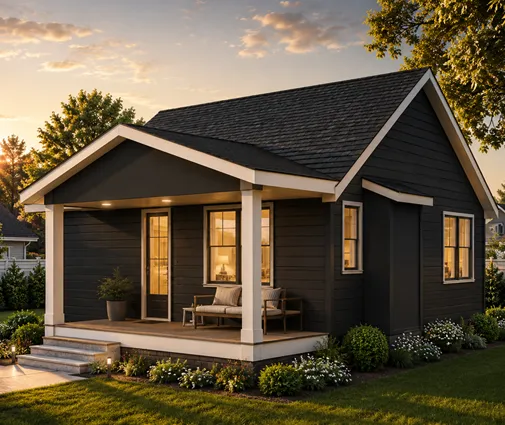
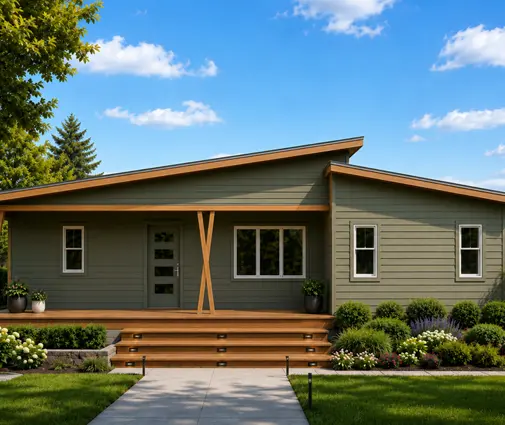
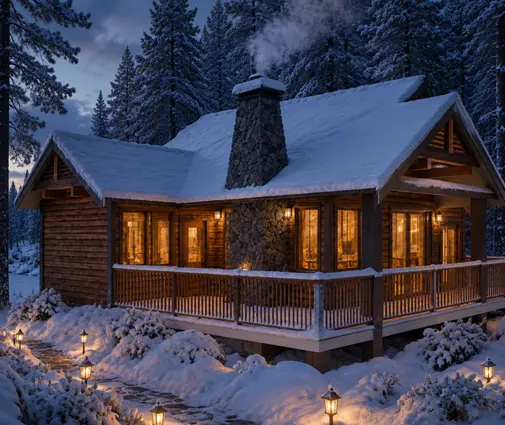
Small footprints also suit modular and panelized builders, whose modules and panels are limited by what fits on a truck. Look at this 750 sq ft two-bedroom cabin, a modern 1,290 sq ft two-bedroom bungalow, or a 982 sq ft one-bedroom modern farmhouse with a garage. All three are the kind of plans a factory can adapt with few changes. Many more sit in the 1,000 to 1,500 sq ft range.
8. Whatever the route, the contract carries the risk
German and Polish families learn this the hard way. A fixed price means little if the scope is vague. In the US, read the contract for the following:
- Price type: fixed price or cost-plus, and whether cost-plus has a cap.
- Allowances: realistic amounts for cabinets, flooring, fixtures and lighting.
- Change orders: they must be written, priced and signed before the work.
- Draw schedule: payments tied to completed, inspected stages, never paid ahead of the work.
- Lien waivers: collect them from the builder and major subcontractors with each payment, so an unpaid supplier cannot place a lien on your house.
- Warranty: what is covered for workmanship, systems and structure, and for how long.
- Site work: who is responsible for grading, utilities, the driveway and the final cleanup.
As an owner-builder, you need the same discipline with each subcontractor: written scopes, proof of license and insurance, and payment only for finished work.
What this means for your build
The European habits are not better, but they are instructive. A Polish site manager and a German Bauleiter exist because someone qualified needs to watch the work. The popularity of turnkey prefab in Germany shows how much families value a single price and a single responsible party. In the US, you can choose freely among a general contractor, owner-building and prefab. With that freedom comes the duty to check your local owner-builder rules, talk to your lender early, and write a tight contract. Start with a simple, complete plan, have a local engineer or drafter adapt it to your lot and code, and then choose the route your budget, your loan and your free time can support.