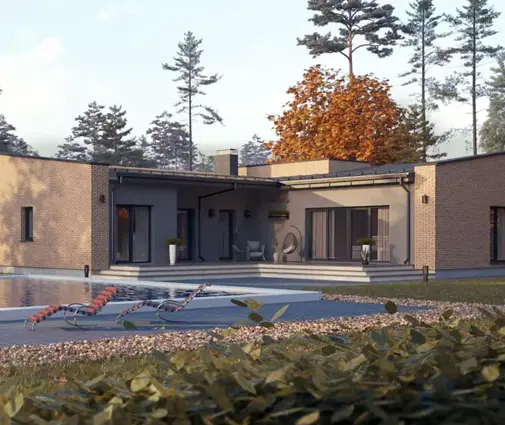
The listing says "20 acres, $4,000 an acre, beautiful views." You picture a long single-story farmhouse with a deep porch facing the sunset. Then you call the county planning office and learn three things: the parcel is zoned agricultural, the minimum lot size for a dwelling is larger than what you are buying, and the only access is a farm lane across a neighbor's field. A bargain can turn into a problem very quickly.
Buying farmland to build a family home is common in the United States, and compared with much of the world it is relatively easy. Looking at how Canada, Germany, Poland and Romania handle the same question shows why. It also shows which questions you should ask before you sign a purchase contract.
How rural land works in the United States
In the US, land use is decided locally. Most rural counties have one or more agricultural or rural residential zoning districts. Many of them allow a single-family home "by right" on a parcel that meets the minimum lot size. Others allow it only as a conditional use. A few prohibit non-farm homes altogether in their most protected farm zones.
What the zoning code usually controls
- Minimum lot size. This can be anything from 1 acre to 40 acres or more, depending on the county and the district.
- Frontage and access. A buildable lot usually needs a minimum width on a public road, or a recorded easement that the county accepts.
- Setbacks. Farm zones often require larger distances from property lines, and sometimes from livestock buildings or streams.
- Number of dwellings. Some codes allow one home per parcel. Others allow one home per set number of acres.
When you need a rezoning
If the home you want is not allowed under the current zoning, you can apply for a rezoning, a conditional use permit or a variance. The usual process looks like this:
- A pre-application meeting with planning staff.
- A formal application with a site plan.
- Notices to neighbors.
- A planning commission hearing.
- A final vote by the county board or city council.
As of 2025, application fees in many counties ran from a few hundred dollars to a few thousand. The whole process typically took two to six months. Nobody can promise approval, though, and neighbors who farm may object.
Two other local factors matter as much as zoning:
- Tax status. In many states, farmland is taxed at a lower agricultural use value. Converting part of it to residential use can trigger rollback taxes for previous years.
- Right-to-farm laws. In most states these protect working farms from nuisance complaints. Your new neighbors' dust, noise and manure are part of the deal.
Canada: protected farmland reserves and limited severances
Canada shows what happens when a province treats farmland as a resource to protect rather than land to develop.
British Columbia has the Agricultural Land Reserve, a provincial zone that overrides local zoning:
- A parcel inside the reserve is generally allowed one principal residence.
- Since 2019, that residence has been capped at roughly 500 square meters of floor area in most cases, which is about 5,380 square feet.
- Additional homes, subdivision and removing land from the reserve all need approval from a provincial commission. Those decisions are slow and often refused.
Ontario works through provincial planning policy. In prime agricultural areas, creating a new residential lot (called a "severance") is tightly restricted. Typical exceptions cover a surplus farmhouse after two farms are merged.
The lesson for an American buyer is that the parcel you buy is usually the parcel you keep. Splitting off a homesite later is much harder there than in most US counties.
Germany: the countryside is closed to ordinary homes
Germany is the strictest of the countries compared here. Its federal building code divides land into planned areas and the "outer area," meaning open countryside. In that outer area, only privileged projects are generally allowed. Examples are a working farm and its farmhouse, or certain utility facilities.
A family home that is not tied to an agricultural business is normally refused, however cheap the land. The legal route to building is for the municipality itself to adopt a development plan that turns the land into a residential area. A private buyer cannot force that. When it happens, it is a public process that typically takes years.
For a US reader, this is the opposite of the American assumption that rural land comes with a right to build one house.
Poland and Romania: conversion is possible, but it takes paperwork
Poland
Polish buyers talk about "odrolnienie," which means taking land out of agricultural production. Whether it is needed, and how expensive it is, depends mainly on the soil class. High-quality soils are protected, while poorer soils are much easier to release.
Where the commune has no local zoning plan, the owner applies for a decision on building conditions. That decision has traditionally required:
- neighboring plots that are already built up,
- access to a public road,
- a realistic way to connect utilities.
Poland has been reforming this system and moving toward commune-wide general plans. Anyone building there should check the current rules locally.
Romania
Romania separates land inside the built-up limits of a locality from land outside them. To build a home on farmland outside those limits, owners often have to:
- commission a zonal urban plan (PUZ),
- bring the land inside the built-up limits,
- pay a fee to take the land out of agricultural use.
Studies, approvals from several agencies and public consultation can stretch the process past a year.
Side-by-side comparison
| Country | Can a non-farmer build a home on farmland? | Who decides | Typical timeline |
|---|---|---|---|
| United States | Often yes, if the lot meets the zoning minimums. Otherwise by rezoning or conditional use | County or city | Weeks if allowed by right, about 2–6 months for a rezoning |
| Canada (BC, Ontario) | One home on an existing parcel is usually possible. New lots are hard to create | Province and municipality | Months to over a year for exclusions or severances |
| Germany | Rarely, unless the home is tied to a working farm | Municipality, through a development plan | Often several years |
| Poland | Often yes, depending on soil class and local plans | Commune | Several months to over a year |
| Romania | Yes, after planning work and conversion of the land | Local council and agencies | Commonly a year or more |
The timelines are rough ranges for 2025 and vary widely by location.
The traps that apply everywhere, including your county
Abroad, zoning is the biggest hurdle. In the US, the more common deal-breakers are physical and practical.
No legal road access
A landlocked parcel, or one reached only by a handshake agreement, may never get a building permit or a mortgage. Insist on a recorded easement that a title company will insure. Also ask whether the county requires a driveway permit or minimum road standards for fire trucks.
No utilities
Rural homes usually depend on a private well and a septic system.
- Septic. A soil test (a perc test or a site evaluation) decides whether a conventional system works. If it does not, you may need an engineered system that costs much more.
- Power. Bringing electricity a long way down a private drive can add thousands of dollars per hundred feet.
- Internet. Check whether broadband is available at all.
Minimum parcel and frontage rules
Buying a 5-acre piece cut from a larger farm can create an illegal lot if the county minimum is 10 acres. Confirm with the planning office that the parcel is a legal lot of record.
Lenders and appraisals
Construction loans on large acreage can be harder to place. Appraisers may struggle to find comparable rural sales. Talk to a lender who knows land before you close.
Choosing a house plan for a rural lot
Room is the one thing farmland rarely lacks, and that changes how you should design. A wide, single-story layout makes sense when you are not squeezed by a narrow city lot. You get no stairs, easy expansion and porches on several sides. Browsing single-story house plans is a good starting point.
For a modest first build on a tight budget, look at this compact three-bedroom cottage of about 1,292 sq ft. It keeps the footprint, the septic sizing and the utility costs small. A step up is a ranch-style farmhouse with a split-bedroom layout. At 1,706 sq ft it still fits a modest budget while feeling generous inside.
Climate and region matter just as much as style:
- Hot, humid South. This Acadian-influenced country home uses deep covered porches to shade the walls.
- North and Midwest. Basements are standard there, and a contemporary single-story plan with a full basement adds storage and a storm shelter without raising the roofline.
Rural life also means equipment: a mower, a utility tractor, a trailer and muddy boots. A Southern country ranch with a three-car garage and a basement gives you room for all of it. Larger families might prefer a four-bedroom modern farmhouse, where the bedrooms are grouped away from the main living space.
The wider farmhouse collection and plans with a three-car garage are worth a look if a workshop matters to you.


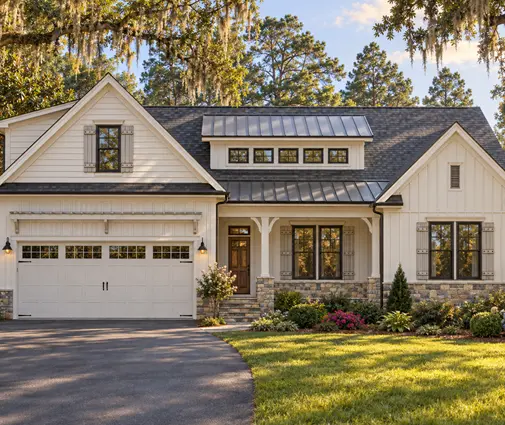
Whichever plan you choose, a local engineer or drafter will usually need to adapt it. That covers your county's adopted version of the International Residential Code, snow or wind loads, the foundation that suits your soil, and the septic layout. Orient the house to the sun and the prevailing wind before you fix the driveway. On open land, nothing else will decide that for you.


Frequently asked questions
Can I build a house on agricultural land in the US?
Often yes. Many rural zoning districts allow one single-family home on a lot that meets the minimum size and frontage. Where they do not, a rezoning or conditional use permit may be possible. Call the county planning office before you buy.
How much does rezoning farmland cost?
As of 2025, county application fees were commonly in the hundreds to low thousands of dollars. Surveys, site plans, legal help and any rollback taxes can add considerably more.
Why is building on farmland so much harder in Europe and Canada?
Many of those jurisdictions protect farmland at the provincial or national level. They also expect new homes to be built in planned settlements, so individual buyers have far less room to convert land than in most US counties.
What type of house plan works best on rural acreage?
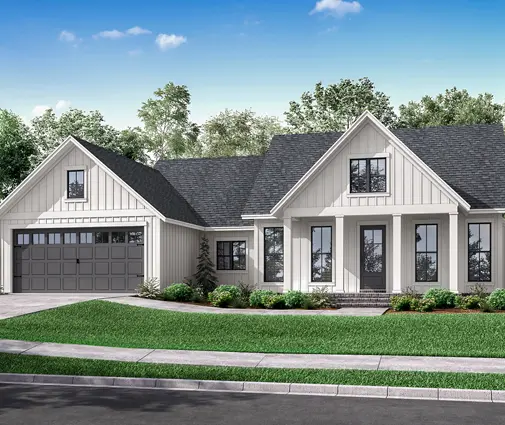
Wide single-story homes, farmhouses and ranches suit rural lots well. Look for porches, a mudroom near the garage, generous garage or shop space, and a footprint your well, septic system and budget can support.