Short answer: yes, for most new homes served by FPL or Duke Energy Florida, solar panels are worth it. Florida still credits the power you send to the grid at roughly the full retail rate, and an all-electric house that runs air conditioning eight months a year uses the most power when the sun is strongest. In 2026, with the 30% federal tax credit for owner-bought systems gone, a typical array on a new Florida home pays for itself in about 12 to 16 years and then keeps saving for another decade or more. Outside Florida the answer depends on your utility. Jacksonville, North Carolina and Virginia fall somewhere in the middle. In Alabama a monthly fee on solar customers stretches the payback so far that panels rarely pay off on money alone.
If you are building rather than buying, you have an advantage. You can choose a roof shape and orientation that fit an array, and you can size the house so the panels cover most of its load. That design work matters as much as the utility rules.
Are solar panels worth it in Florida? The numbers for a new home
The table compares the same house in five service areas. Treat every figure as a range for planning, not a quote.
Assumptions (2026):
- House: a 2,200 sq ft one-story home, all-electric, built to current code, with a heat pump.
- Use: about 12,000 to 13,500 kWh a year.
- Array: an 8 kW system bought outright, with no battery, installed while the house is built.
- Cost: about $2.50 to $3.10 per watt with no federal credit.
- Rates: held flat. Future rate increases would shorten every payback.
| Service area | Yearly bill, no solar | Yearly bill, with solar | Extra build cost | Savings over 10 years | Savings over 20 years | Simple payback |
|---|---|---|---|---|---|---|
| Florida, FPL or Duke Energy Florida | $1,900–2,300 | $350–650 | $20,000–25,000 | $15,000–17,000 | $29,000–34,000 | 12–16 years |
| Jacksonville, JEA | $1,700–2,000 | $600–900 | $20,000–25,000 | $10,000–12,500 | $20,000–25,000 | 16–22 years |
| North Carolina, Duke Energy | $1,650–2,000 | $450–800 | $20,000–25,000 | $11,000–14,000 | $22,000–28,000 | 15–20 years |
| Virginia, Dominion | $1,750–2,100 | $300–600 | $20,000–25,000 | $13,500–16,000 | $27,000–32,000 | 13–17 years |
| Alabama, Alabama Power | $2,000–2,400 | $1,400–1,900 | $20,000–25,000 | $4,000–7,000 | $8,000–14,000 | 30+ years |
Panels degrade slowly, usually under 1% a year, and an inverter may need replacing once in 20 years. Both trim the long-term savings a little. The 20-year column also does not count higher appraisal value. Appraisers in the Southeast treat solar unevenly, so that value is not guaranteed.
How the rules differ from state to state
Florida: FPL and Duke Energy Florida
Investor-owned utilities in Florida still use one-to-one net metering under the state Public Service Commission rule. Each kilowatt-hour you export offsets one you buy later, and any surplus carries forward within the year. You still pay the fixed customer charge each month.
Florida also exempts residential solar equipment from sales tax. It also keeps the added value of the system out of your property tax assessment. Lawmakers have tried to cut net metering before, so check the current rule before you sign. Systems approved under the old terms have generally kept them.
Are solar panels worth it in Jacksonville, FL?
Usually, but less clearly than elsewhere in the state. JEA is a city-owned utility, so it sets its own rules. Since 2018 it has credited exported power at a rate well below what you pay to buy power. That means the panels pay best when the house uses their output as it is produced. Air conditioning in the afternoon does that well.
A smaller array of 5 to 6 kW, matched to daytime use, often beats a large one in Jacksonville. Adding a battery shifts more of the output into the evening. At 2026 prices, though, a battery adds roughly $10,000 to $15,000 and rarely pays for itself on JEA rates alone. Most buyers add one for backup power during storms.
Are solar panels worth it in NC?
For many North Carolina households they are, with a 15 to 20 year payback. Duke Energy's newer residential solar tariffs pair net billing with time-of-use rates. Exports are credited under a less generous formula, and a monthly minimum charge applies.
Orientation and timing matter more under these rules. A west-facing array that keeps producing into the late-afternoon peak earns more than its raw kilowatt-hours suggest. Duke has offered rebates for pairing solar with a battery in some years. Check whether a program is open when you apply.
Are solar panels worth it in Virginia?
In Dominion territory they are, with a payback close to Florida's. Dominion still offers retail-rate net metering, settled once a year. Regulators have been reviewing those terms, so a house built in 2027 may face different rules than one finished today.
Appalachian Power and the electric cooperatives in the west and south of the state set their own terms. Ask your specific utility.
Are solar panels worth it in Alabama?
Rarely, on savings alone. Alabama Power charges solar customers a monthly fee based on the size of the system, historically around $5 per kW of panels. It credits exported power at a low avoided-cost rate. For an 8 kW array that fee alone can eat a third or more of the yearly savings.
Homeowners in Alabama who go solar usually do it for backup power with a battery, or because their rural cooperative has friendlier terms. If you build there, wire for future panels and put the money into the building envelope first.
Why heavy cooling loads make solar fit the South
In the North, solar output peaks in summer while the heating bill peaks in winter. In Florida and the Gulf states the two curves line up. The hottest, sunniest hours are when the air conditioner works hardest, so solar output and household use rise and fall together. That is why even reduced export credits, as in Jacksonville or North Carolina, still leave a reasonable payback.
Cutting the load first is cheaper than buying more panels. Every kilowatt-hour you avoid is one you do not have to generate. These measures cut the load:
- Insulation and radiant barriers: attic insulation of R-38 or more, or an unvented attic with spray foam under the roof deck. These keep the air ducts out of a 130°F attic and can cut cooling use noticeably.
- Low-SHGC windows and deep overhangs: they block solar heat at the glass. This matters more in the South than a high R-value.
- Airtightness: sealing to the blower-door targets of the current energy code keeps humid outside air out. This lowers the dehumidifying work the air conditioner has to do.
- Variable-speed heat pump: it cools and dehumidifies efficiently and handles the short winters without gas.
- Energy recovery ventilation: it brings in fresh air while recovering part of the cooling and some of the moisture from the outgoing air.
Most states in the region build to a version of the IECC through the IRC. Florida uses its own Florida Building Code energy chapter. A tighter target such as ENERGY STAR, the DOE Zero Energy Ready Home program, or a Passive House certification under PHIUS can cut cooling demand by a third or more compared with a minimum-code house. On a home that efficient, a 6 kW array may do what 8 kW would do on a typical one.
Hurricane-rated mounting: what to ask for
Along the coast, design wind speeds under ASCE 7 commonly run from about 140 to over 170 mph. The array must stay on the roof at those speeds. In Florida, the racking should carry a state product approval, and in Miami-Dade and Broward counties it should carry a county approval for the High-Velocity Hurricane Zone. An engineer should sign off the layout for your exact wind speed and exposure.
Points to check with the installer and your plan drafter:
- Attachment: rails should be anchored into rafters or trusses, not just the sheathing, at the spacing the engineer requires. Edges and corners need tighter spacing.
- Clear zones: keep panels back from roof edges and ridges. This reduces wind uplift and meets the fire-access pathways the code requires.
- Flashing: each penetration needs flashing rated for your roof covering, whether shingle, metal or tile.
- Structure: trusses must be designed for the extra dead load. Tell the truss supplier about the array before fabrication.
The roof-replacement timing problem
An architectural shingle roof in Florida often lasts 15 to 20 years. Panels last 25 to 30. If both go on at the same time, the roof will likely wear out first. Then you pay roughly $2,500 to $5,000 in 2026 dollars to remove and reinstall the array, on top of the reroof.
On a new build you can avoid most of that cost:
- Choose a standing-seam metal roof under the array. It can last 40 years or more, and clamps attach without drilling through the panels' surface.
- If you choose shingles, upgrade the underlayment and use the highest wind-rated product.
- If you are not buying solar yet, have the electrician run a conduit from the attic to the panel location and leave space for a breaker. Then you can add the array later without opening walls.
Insurers in Florida also look at roof age. A new roof with documented attachments usually makes the array easier to insure.
Choosing a hip-roof plan with room for panels
Hip roofs are popular across the Southeast because they resist hurricane winds better than tall gable ends. Their weakness for solar is that hips and valleys cut each slope into triangles and trapezoids. An 8 kW array needs roughly 400 to 450 sq ft of clear, unbroken roof. A long, simple footprint with few bump-outs gives you that on the south slope. A broad rear roof facing east or west works almost as well in Florida, losing only about 10 to 15%. Browse house plans with hip roofs and favor long rectangles over heavily jogged outlines.
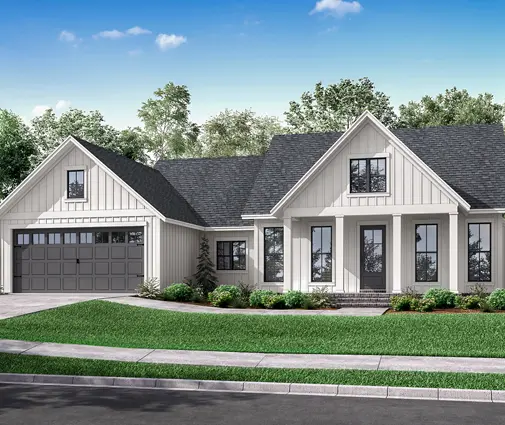
A one-story rectangle is the easiest case. The three-bedroom modern farmhouse ranch keeps its living space in a simple, wide block of 1706 sq ft. That leaves long, clean roof planes and a load small enough for a 6 to 7 kW array to cover. The Craftsman plan at 2007 sq ft has a similar compact single-level footprint and suits a family that wants three bedrooms without a sprawling roof.
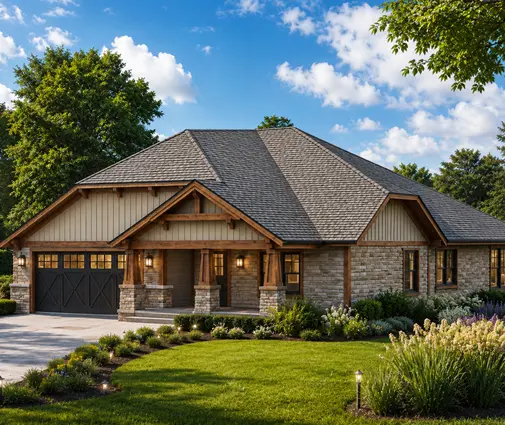

Formal styles can work too. The Georgian one-story with four bedrooms has the symmetrical, boxy massing that gives a hip roof broad slopes on each side. The Acadian Low Country plan combines deep porches with a footprint of 1879 sq ft. The porches shade the windows and cut cooling load, which matters as much as the panels.
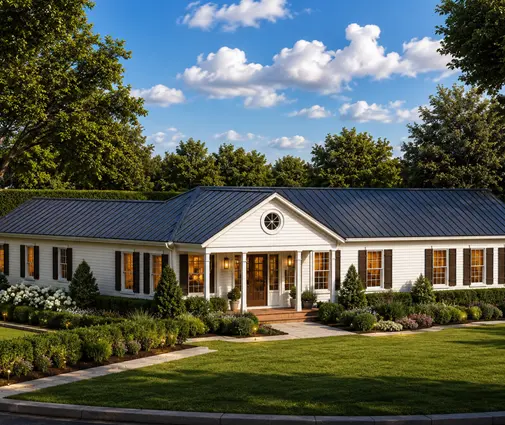
Larger homes need more roof and also use more power. The 2508 sq ft farmhouse ranch with a three-car garage adds a garage roof that can carry part of the array, out of sight from the street. The traditional ranch at 2565 sq ft spreads its rooms along one level, so the rear slope is long and uninterrupted.

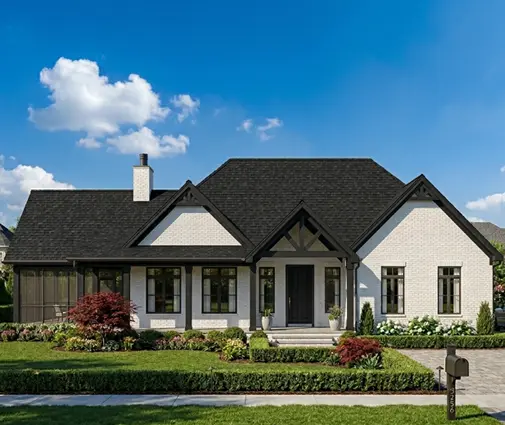
Before you buy a plan, ask the drafter who adapts it to your lot to check three things:
- The orientation of the largest slope on your actual lot.
- Shading from trees and neighboring houses.
- Any HOA rules on visible panels. Florida law limits how far an HOA can ban them, but it may still have a say in placement.
Then compare the finalists in the hip roof plan collection, alongside other one-story designs that keep the roof simple.
FAQ
Is it cheaper to add solar while the house is being built?
Usually, yes, by a few thousand dollars. Wiring, roof attachments and permits are combined with the construction work. The array can also be included in the mortgage, though the appraisal may not count its full cost.
Do I need a battery in Florida?
Not to make solar pay back under FPL or Duke Energy Florida, because net metering already works like a free battery. A battery mainly buys backup power during outages. It helps the math more in Jacksonville and North Carolina, where exported power earns less.
How long do panels last in hurricane country?
Properly rated and attached panels typically carry 25-year performance warranties and often survive major storms. Check that your homeowner's policy covers the array, and keep the engineering and approval documents from installation.
What size system does a new 2,200 sq ft home need?
In most of the Southeast, about 7 to 9 kW covers an all-electric home built to current code. An envelope built well above code can bring that down to 5 or 6 kW. Ask your installer to size the array from the energy model of your plan, not from a rule of thumb.