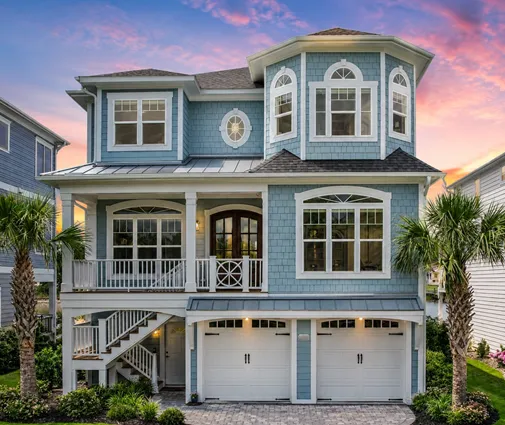
Are solar panels worth it on a new house now that the 30% federal tax credit is gone? Often yes, but less often than before. On a 2,000 sq ft all-electric home with an unshaded south- or west-facing roof, a utility that credits exports at or near the retail rate, and plans to stay ten years or more, an 8 kW system bought in cash usually pays back in roughly 10 to 15 years and earns more than it cost over its life. Take away net metering, add shade or a choppy roof, or plan to sell in five years, and the payback can stretch past 20 years. At that point the panels are not worth it financially.
The good news for anyone still at the design stage is that the house plan controls several of these variables. A new build gets a cheaper installation than a retrofit, and you can choose roof shape, orientation and wiring before anything is framed.
What changed in 2026
The Residential Clean Energy Credit let homeowners deduct 30% of the system cost from their federal taxes. It ended for homeowner-owned systems installed after 2025. Leases and power purchase agreements, where the installer owns the panels, may still carry a business credit for a limited time. Some of that value can show up in a lower monthly payment, so ask how it is reflected and get it in writing. State rebates, utility incentives and property tax exemptions still exist in some places. Check with your state energy office and your utility before you price anything.
So are solar panels still worth it? The question has shifted from "how big is the credit" to "how much does my utility pay for my electricity, and how much of it can my roof make."
The cost breakdown for an 8 kW system
In 2025 and 2026, installed prices for residential systems typically ran about $2.25 to $3.50 per watt before incentives. A system designed into a new house during construction usually lands at the lower end, because the conduit, the panel space and the roof are planned for it. The table below breaks down a typical 8 kW system (about 20 panels of 400 W each).
| Cost item | Typical range, 8 kW (2026, USD) | Notes |
|---|---|---|
| Panels | $3,500 – $5,500 | Price varies with efficiency and warranty |
| Inverter or microinverters | $1,500 – $3,500 | Microinverters cost more but handle partial shade better |
| Racking, wiring, disconnects | $1,500 – $3,000 | Cheaper on simple asphalt-shingle planes |
| Installation labor | $3,000 – $5,000 | Lower if coordinated with roofing and electrical rough-in |
| Permit, plan review, interconnection | $500 – $2,000 | Set by your city or county and the utility |
| Design, sales, overhead | $3,000 – $6,000 | Often the largest hidden share of a quote |
| Main panel upgrade | $0 – $3,000 | Usually $0 on a new house specified with a 200 A service |
| Total, no battery | $18,000 – $28,000 | About $2.25 – $3.50 per watt |
| Optional battery, ~13 kWh | $10,000 – $16,000 | Backup power; savings only where export credits are low |
Are solar panels worth it financially? The payback math
Assumptions: a 2,000 sq ft all-electric house in 2026 with a heat pump for heating and cooling, a heat pump water heater and an induction range, built to current energy code. It uses about 11,000 kWh a year at an average residential rate of 15 to 18 cents per kWh. That rate is near the national middle in 2025; your state may be far above or below it. In a sunny region the 8 kW system produces close to 11,000 kWh a year, and in the cloudy North closer to 9,000. Savings include modest yearly rate increases.
| Scenario | Yearly electric cost | Extra build cost | Savings over 10 years | Savings over 20 years | Payback |
|---|---|---|---|---|---|
| No solar | $1,650 – $2,000 | $0 | — | — | — |
| 8 kW, full net metering | $200 – $400 (fixed charges) | $18,000 – $24,000 | $14,000 – $18,000 | $32,000 – $42,000 | 11 – 15 years |
| 8 kW, net billing (exports credited at 4 – 8 cents) | $800 – $1,100 | $18,000 – $24,000 | $8,000 – $11,000 | $17,000 – $24,000 | 18 – 25 years |
| 8 kW + battery, net billing | $400 – $700 | $30,000 – $40,000 | $11,000 – $15,000 | $24,000 – $32,000 | 22 – 30 years |
| Efficiency first: better insulation, airtightness, heat pump water heater, no solar | $1,250 – $1,550 | $4,000 – $9,000 | $4,000 – $6,000 | $9,000 – $13,000 | 8 – 14 years |
Two lessons stand out. First, net metering matters more than the panels themselves. Under full net metering, the grid acts as a free battery, so every kWh you make is worth the retail rate. Under net billing, power you export at noon earns a fraction of what you pay at 7 p.m. Second, efficiency is cheaper per dollar saved than generation. Extra attic insulation, careful air sealing and a heat pump water heater cut what the house needs. You can then size the array at 6 kW instead of 8 kW and save several thousand dollars up front.
This also places solar within energy standards. The IECC energy chapter adopted by your state sets the minimum envelope. Programs such as ENERGY STAR and DOE Zero Energy Ready Home go further, and a passive house goes furthest. A passive house uses very thick insulation, triple-pane windows, near-perfect airtightness and ventilation with heat recovery, which brings fresh air in while keeping most of the heat. A passive house may need only 4 to 5 kW of panels to reach net zero. California already requires solar on most new single-family homes, so in that state the question is about sizing, not whether to install it.
How the house plan sets your solar budget
8 kW of panels takes about 420 sq ft of panel area. With the fire-code access paths along ridges and edges (often around 3 feet; check your local fire code), you need roughly 500 to 650 sq ft of usable roof facing south, or east and west. Simple, large planes cost less to rack and wire than many small ones. That is why browsing house plans with a gable roof is a sensible start: one long ridge running east to west leaves a single wide south plane.
A single-story footprint helps too. The 3-bedroom Craftsman plan at 2007 sq ft matches the assumptions in the table almost exactly. Spread over one floor, its roof offers more than enough south-facing area for 8 kW. The Modern Farmhouse ranch of 1993 sq ft is similar in size. If you set it on the lot with its long side to the south, the array can go on one plane without wrapping around hips. A smaller home like the 1706 sq ft three-bedroom ranch uses less power, and a 6 kW system may cover it.
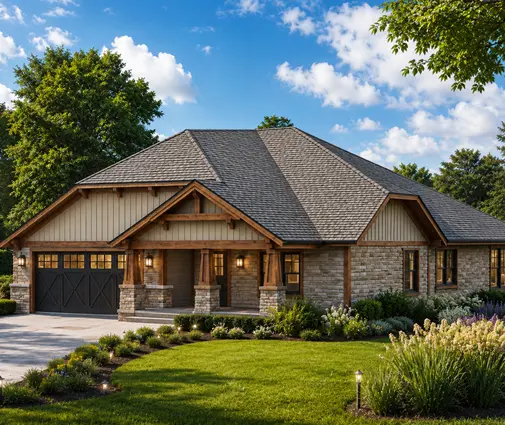

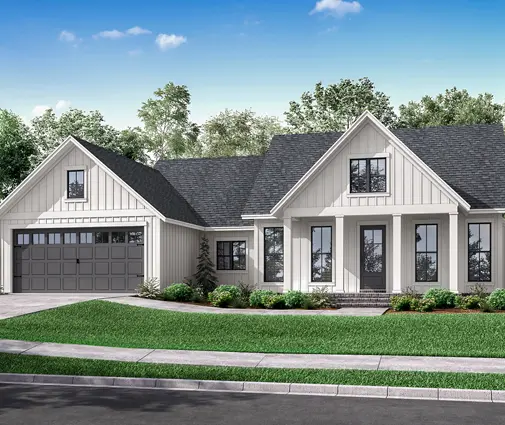
Clean, minimal roofs are easiest of all. The Scandinavian-style plan at 2168 sq ft pairs restrained modern lines with an open layout that suits a heat pump well. Size cuts the other way too: a 4,304 sq ft home such as this large Craftsman-Shingle design may use 50% more energy. Big houses also tend to break their roofs into more sections, so get a roof plan before assuming the array will fit. Steep, picturesque styles like the Tudor and Storybook lines of this French Country home are charming, but small dormers and intersecting gables leave fewer panel-sized surfaces.
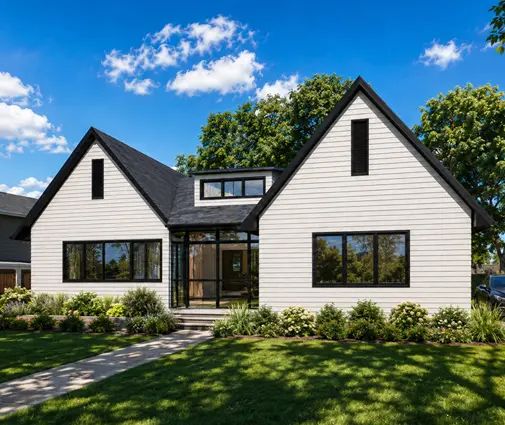

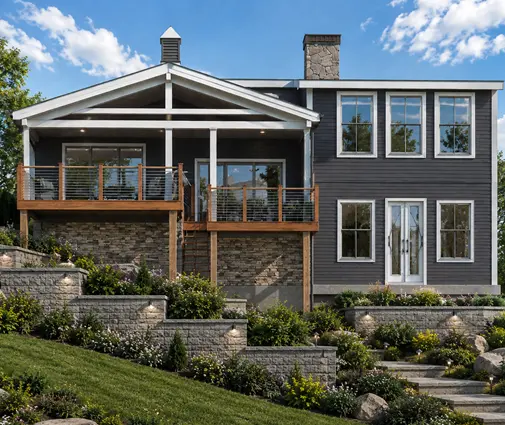
For a family that needs four bedrooms, the 2742 sq ft Modern Farmhouse is a good test case. Budget 9 to 11 kW and confirm the garage roof can carry part of the array. In a basement plan like the 1906 sq ft Transitional home, the mechanical room downstairs makes a natural place for the inverter and an optional battery.
When solar panels are not worth it on your house
- Shaded lots. Mature trees, a taller neighbor or a ridge to the south can cut output by a third or more. Ask for a shade analysis before you buy the lot, not after.
- Complex roofs. Hips, valleys, turrets and many dormers raise labor costs and lower capacity. Some roofs cannot fit more than 4 to 5 kW.
- Low electric rates. At 11 to 13 cents per kWh, common in parts of the South, Midwest and Northwest, payback without net metering can pass 25 years.
- Short ownership. If you will sell within five to seven years, you probably will not recover the cost. Appraisers do not always credit owned solar at full value, and leased systems can complicate a sale.
- Roof replacement soon. Panels last 25 to 30 years. Pair them with a roof rated for the same life so you do not pay to remove and reinstall them.
- HOA limits. Many states restrict HOAs from banning solar, but placement rules can still push panels to a worse roof face. Read the covenants early.
How to save if you build with solar
- Make the house solar-ready even if you install later: run a conduit from attic to panel, reserve breaker space and keep one roof plane clear of vents and skylights. This costs a few hundred dollars now and saves thousands later.
- Cut demand first. Insulation, airtightness and a right-sized heat pump shrink the array you need.
- Get three quotes in dollars per watt, and compare warranties on panels, inverters and workmanship.
- Learn your utility's export rules before sizing. Under net billing, a smaller array that covers daytime use often beats a big one.
- Pay cash or use the mortgage if you can. Long solar loans with dealer fees can add 20% or more to the real cost.
Solar panels pros and cons: summary
- Pros: lower bills for 25+ years, protection from rate increases, cheaper installation on a new house, and backup power with a battery.
- Cons: no federal credit for owned systems, $18,000 to $28,000 up front for 8 kW, weak returns under net billing, and poor results on shaded or complex roofs.
- Payback for a 2,000 sq ft all-electric home: about 11 to 15 years with net metering, 18 to 25 without.
- Panels are actually worth it when the roof is simple and sunny, rates are high and you plan to stay.
- Check local rules, incentives and interconnection terms with your city or county, utility and designer before you commit.
If solar is part of your plan, start with the roof. Shortlist homes in the 2000–2500 sq ft range and compare their roof lines among these gable roof house plans before your lot and orientation are fixed.