Are solar panels worth it in Texas? On a new, well-insulated single-story house they usually are, but slowly: with 2026 prices and no federal homeowner tax credit, a typical system pays for itself in roughly 13 to 20 years and keeps producing for 25 years or more. The answer depends less on sunshine, which Texas has plenty of, and more on three things you can control: who buys the power you send back to the grid, how much of your own output you use, and whether your roof was designed to hold panels in the first place. Texas has no statewide net metering, so the same panels can pay back years faster in one ZIP code than in the next.
The steps below follow the order a family building a house actually faces these decisions, from choosing a plan to switching on the system. The example house is a 2,200 sq ft slab-on-grade ranch, the kind of home that fills new subdivisions around Houston, Dallas and Austin.
Step 1: Find out who sells you electricity
Before you price a single panel, look up your new lot's electric service. Most of Houston and Dallas sit in the ERCOT deregulated market: the wires belong to a utility, but you pick a retail electric provider, and some of those providers offer solar buyback plans. Austin is served by a city-owned utility that sets its own solar credit. Many rural and exurban lots fall under an electric co-op, and co-op policies range from crediting exported power at close to the retail rate to paying only a small wholesale price.
Time: an afternoon of phone calls. Cost: nothing. Ask the utility or co-op directly how exported power is credited, whether there is a monthly fee for solar customers, and whether the policy is guaranteed for any number of years.
Step 2: Cut the load before you size the panels
Every kilowatt-hour you never use is cheaper than one you produce. In Texas the big load is air conditioning, so the house shell does most of the work. Texas sets a statewide minimum energy code based on an older edition of the IECC, and cities such as Austin enforce newer editions. Going a bit beyond the minimum is where solar starts to make sense:
- Insulation: 2x6 walls with full cavity insulation and continuous exterior foam, plus a sealed or well-insulated attic, keep heat out of the living space.
- Windows: low solar heat gain glass on the west and south walls cuts afternoon peaks.
- Airtightness: a blower-door-tested shell stops humid air from leaking in, which matters as much in Houston as the insulation itself.
- Heat pump: a variable-speed unit cools efficiently and replaces gas heat for the few cold weeks.
- Ventilation with heat recovery: an energy recovery ventilator brings in fresh air while holding back much of the outdoor heat and moisture.
Passive house standards take this to an extreme; you don't need certification, but borrowing the principle (shell first, equipment second) can trim yearly use from 15,000 kWh toward 12,000 kWh in a house this size. Cost: often $5,000 to $15,000 over a code-minimum build in 2026, depending on the builder.
Step 3: Pick a roof that can hold the panels
An 8 kW system needs about 20 modern panels, or roughly 400 to 450 sq ft of clear roof, plus the fire-access setbacks at ridges and edges that the code requires. On a one-story house that is easy, if the roof shape cooperates. Browsing ranch house plans with solar in mind, look for:
- A long ridge running east to west. A gable roof with that orientation gives one large, uninterrupted south-facing plane, the best case for panels.
- A garage roof facing south or west. The garage wing of a ranch often supplies the cleanest rectangle on the whole house.
- Fewer cuts. A hip roof handles wind well but chops the surface into trapezoids and triangles, so you lose usable area to edges. Dormers, valleys and plumbing vents on the sunny side do the same.
- A moderate pitch. Roughly 4/12 to 6/12 works well in Texas and is safe to install on.
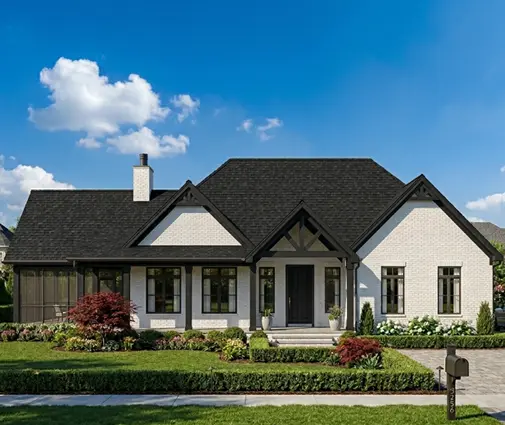
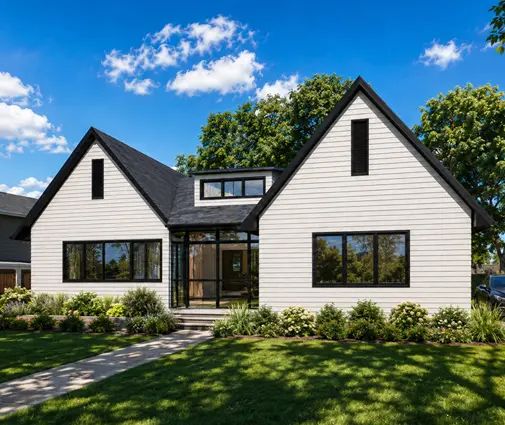
A plan close to our example size, such as this 2,250 sq ft modern ranch with three bedrooms, is a good candidate to review with your drafter for vent placement and orientation on the lot. If you need four bedrooms in the same footprint, this single-story plan at 2,209 sq ft keeps everything on one level, which also keeps the attic ducts short.

Time: part of plan selection. Cost: usually nothing extra if decided before drafting; moving vents to the north side is a note on the drawings, not a change order.
Step 4: Size the system to what you use yourself
Because export credits in much of Texas are lower than what you pay for power, the most valuable kilowatt-hour is the one you consume the moment it is produced. Running the pool pump, dishwasher and an EV charger in the middle of the day raises that share. A system sized to cover 70 to 90 percent of yearly use is usually the sweet spot; oversizing mainly adds cheap exports.
Batteries store midday output for the evening AC peak and keep the lights and the fridge on during outages, a real concern after the winter storm of 2021 and the Houston hurricane outages of 2024. They also add roughly $10,000 to $16,000 for a typical home battery in 2026 and lengthen the payback. Buy one for resilience, not to beat the spreadsheet.
Time: one or two quotes. Cost: free from installers, though you should ask each one to show the self-consumption share they assumed.
Step 5: Are solar panels worth it in Texas? Run the payback math
Here is the estimate for the example house. Assumptions for 2026: 2,200 sq ft slab ranch built a step above code, about 14,000 kWh of use per year, an 8 kW roof system installed during construction for about $20,000 to $24,000 in cash, no federal tax credit (the 30 percent homeowner credit ended for systems placed in service after 2025), half of the output used on site, and flat electricity prices with no inflation. In Houston and Dallas, exports are credited by a retail buyback plan at 4 to 12 cents per kWh; Austin credits all solar output through its own value-of-solar rate, which has been around a dime per kWh in recent years.
| Estimate, 2026 | Houston (retail plan) | Dallas (retail plan) | Austin (city utility) |
|---|---|---|---|
| Assumed average price | about 15 cents/kWh | about 15 cents/kWh | about 13 cents/kWh |
| Yearly electric bill without solar | $1,900 to $2,250 | $1,900 to $2,250 | $1,700 to $1,950 |
| Yearly solar output, 8 kW | about 10,800 kWh | about 11,600 kWh | about 12,000 kWh |
| Yearly electric bill with solar | $650 to $1,100 | $550 to $1,000 | $500 to $700 |
| Yearly savings | $1,000 to $1,450 | $1,100 to $1,550 | $1,150 to $1,300 |
| Extra building cost | $20,000 to $24,000 | $20,000 to $24,000 | $20,000 to $24,000, less any city rebate |
| Savings over 10 years | $10,000 to $14,500 | $11,000 to $15,500 | $11,500 to $13,000 |
| Savings over 20 years | $20,000 to $29,000 | $22,000 to $31,000 | $23,000 to $26,000 |
| Simple payback | about 14 to 22 years | about 13 to 20 years | about 15 to 19 years |
The spread in Houston and Dallas is almost entirely the buyback plan. A plan that credits exports close to the retail rate puts you at the short end; a wholesale-price plan puts you at the long end. If electricity prices keep rising, as they have over the past decade, every row improves. Some lenders and appraisers also give credit for owned panels at resale, while leased panels can complicate a sale, so pay cash or finance the system with the mortgage rather than leasing.
Step 6: Specify panels and mounts for Texas weather
Hail is the Texas risk that rarely shows up in a payback chart. Ask for panels tested for larger hail impact, tempered glass, and a frame rated for the snow and wind loads your county requires. On the Gulf Coast, the racking must meet the wind design of the house itself, so the attachments should appear on the engineered drawings. Call your insurer before you sign: some policies cover panels as part of the dwelling, others need an endorsement, and a cosmetic-damage exclusion on the roof can extend to the array.
Cost: often a few hundred dollars more for higher-rated panels and hardware, cheap insurance against one bad storm.
Step 7: Clear the HOA, the permit and the tax office
Under Texas property law, most HOAs cannot forbid solar panels on your own roof. They can set reasonable rules, such as asking for panels on a side that doesn't face the street when that location produces nearly as much, so submit a layout to the architectural committee early. The city or county issues the electrical and building permits, usually within a few weeks when the array is on the original house drawings.
Texas also exempts the value that solar adds to your home from property tax. The exemption is not automatic: file the application with your county appraisal district after installation. On a system worth $20,000 or more, that is a real yearly saving in a state where property taxes are high.
Step 8: Interconnect and choose your plan
Once the inspector signs off, your installer applies to the utility to connect the system, and a bidirectional meter goes in. In a deregulated area, this is the moment to shop retail plans: compare the buyback rate, any cap on credits, the monthly fee and the contract length, not just the advertised energy price. Re-shop every time your contract ends; buyback terms change often.
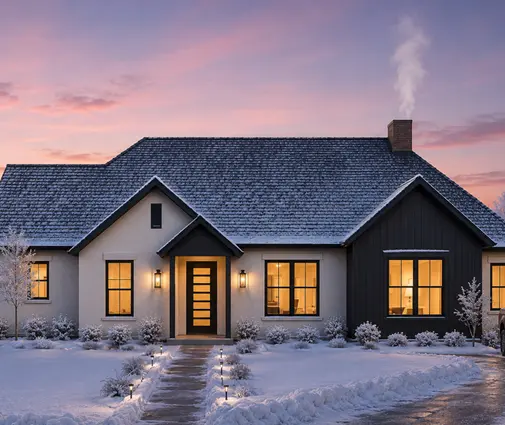
If you want the garage roof to carry the array, a plan such as this four-bedroom farmhouse ranch with a three-car garage or this three-bedroom modern ranch with a wide garage wing gives extra roof to work with. For a larger family, this 2,600 sq ft modern ranch spreads four bedrooms over one level, and the 2,168 sq ft modern farmhouse keeps a compact footprint close to our example.


Timeline from plan to first bill
| Step | When | How long | Typical cost, 2026 |
|---|---|---|---|
| 1. Identify utility or provider | Before buying the lot | 1 day | Free |
| 2. Upgrade the shell | During design | 1 to 2 weeks with the drafter | $5,000 to $15,000 |
| 3. Choose roof shape and orientation | Plan selection | Part of design | Usually none |
| 4. Size the system, decide on a battery | Before drawings are final | 1 to 2 weeks for quotes | Battery $10,000 to $16,000 optional |
| 5. Run payback numbers | With the quotes | A few hours | Free |
| 6. Specify hail- and wind-rated equipment | Contract stage | Included in quotes | A few hundred dollars |
| 7. HOA approval, permits, tax exemption | Before and after install | 2 to 6 weeks | Permit fees, varies by city |
| 8. Interconnection and retail plan | After final inspection | 2 to 6 weeks | Usually none |
So, are solar panels worth it in Texas? On a tight new house with a roof drawn for panels and a fair buyback deal, yes, with a payback in the teens and a decade or more of nearly free daytime power after that. Check the current rules with your utility, appraisal district and engineer, then start where the savings start: with the plan. Browse single-story ranch designs and pick one with a broad, simple roof facing the sun.