It is -10°F outside, the wind is coming across the field, and your new house is sitting at 68°F. Ten years ago most HVAC contractors in the upper Midwest would have told you only a gas furnace could do that reliably. Today a cold-climate air-source heat pump can, and many builders now quote two options: all-electric with a cold-climate unit, or dual-fuel, meaning a heat pump paired with a gas furnace that takes over when it gets very cold. Both work. Which one is right depends on your climate zone, your utility rates and the house itself. Much of the advice going around is out of date or just wrong, so here are the most common myths and what is actually true.
Myth 1: Heat pumps stop working once it drops below freezing
Fact: That was roughly true of older, single-speed units, which lost much of their output in the 20s and leaned hard on electric backup below that. Current cold-climate models use variable-speed (inverter) compressors and are built to keep delivering heat at 5°F and below. Many are rated to keep running down to -13°F or even lower. Efficiency does drop as it gets colder. A unit that moves three units of heat per unit of electricity on a 40°F day may be closer to 1.5 to 2 at 5°F. But it is still well above the 1-to-1 of plain electric heat. When you compare models, look at the published capacity at 5°F, not only the rating at 47°F.
Myth 2: A cold-climate heat pump means you never need backup heat
Fact: Every heat pump has a thermal balance point. That is the outdoor temperature where the unit's output exactly matches the heat the house is losing. Below it, something has to fill the gap. In a tight new house with a well-matched cold-climate unit, the balance point might sit somewhere around 0°F to -10°F. That is fine in Columbus or Detroit, where the design temperatures used for sizing are typically in the single digits above zero. In the Twin Cities or northern Minnesota, design temperatures run into the minus teens, and real cold snaps go colder. There, plan on some backup no matter which system you choose. Defrost cycles also briefly cut output on humid, cold days.
Myth 3: Electric heat strips are a fine backup for every hour below the balance point
Fact: Resistance heat strips (commonly 5 to 20 kW in an air handler) are reliable and cheap to install. They are also the most expensive way to heat per hour of use. For a few hours on the coldest nights of the year, that is acceptable. If a heat pump is undersized or the house is leaky, though, the strips can run for days, and the January bill will show it. The strip size also drives your electrical service. Large strip kits can push a house toward a 200-amp or bigger panel, so plan for that early, not after the drywall is up. A gas furnace as the backup in a dual-fuel system avoids most of this cost wherever natural gas is already at the street.
Myth 4: Size the heat pump for the coldest night and you are covered
Fact: Oversizing a heat pump to meet the full heating load at -15°F usually means it is badly oversized for cooling. In July it will short-cycle, remove little humidity and leave the house clammy. The standard approach is a room-by-room Manual J load calculation, then equipment selected under Manual S. Pick a variable-speed unit that covers most or all of the heating load at your design temperature without being far too big for summer, and let backup heat handle the remainder. Variable-speed equipment gives you more room here because it can run at low output most of the year. Ask the contractor for the written load calculation, not a rule of thumb like "one ton per 500 square feet."
Myth 5: A basement doesn't change the sizing
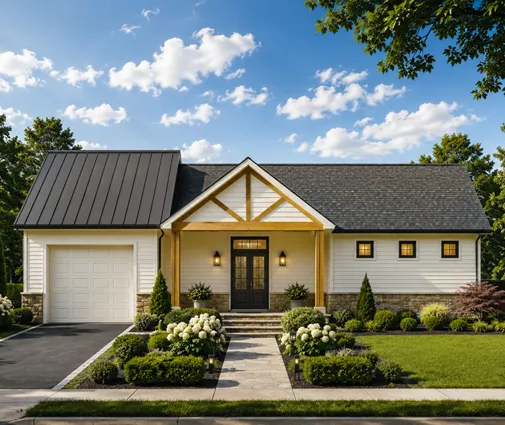
Fact: A full basement adds conditioned volume, rim joist and above-grade wall area to the heating load. In a finished walkout, it also adds windows and an exterior door. Below-grade walls lose heat more slowly than above-grade walls, because the soil buffers them. So a basement doesn't simply add load in proportion to its square footage, which is exactly why a proper load calculation matters. A compact single-story home like this 1,764 sq ft Craftsman with three bedrooms and a full basement may need a surprisingly modest heat pump once the basement walls are insulated. The same goes for this 1,777 sq ft single-story farmhouse. Duct the basement properly too. A finished lower level that only gets a couple of supply registers will feel cold in January no matter what equipment sits in the mechanical room. You can browse more house plans with basements and compare footprints.


Myth 6: A heat pump is always cheaper to run than gas
Fact: It depends on local prices, and in much of the Midwest natural gas is still cheap. The table below uses illustrative mid-2020s numbers: natural gas around $1.20 per therm, electricity around $0.16 per kWh. Residential electricity in Michigan has often run higher than in Minnesota or Ohio, and both gas and electric rates vary by utility. Take your own bills and redo the math.
| Heat source | Assumed efficiency | Approx. cost per million BTU delivered |
|---|---|---|
| Gas furnace | 95% AFUE | about $12.60 |
| Heat pump, mild day | COP 3.0 | about $15.60 |
| Heat pump, around 5°F | COP 2.0 | about $23.40 |
| Heat pump, deep cold | COP 1.5 | about $31.30 |
| Electric heat strips | COP 1.0 | about $46.90 |
At these prices gas wins on cost per unit of heat in cold weather. The picture changes with discounted electric rates. Some Midwest utilities, including several in Minnesota, have offered lower rates for dual-fuel or off-peak electric heating. At around $0.12 per kWh, a heat pump at COP 3 drops to roughly $11.70 per million BTU, which beats gas. On the other hand, an all-electric house drops the monthly gas customer charge, and that can be worth a few hundred dollars a year. Ask your utility which rates apply to new construction.
Myth 7: Dual-fuel is a compromise that gives you the worst of both
Fact: In the colder parts of the Midwest, dual-fuel is often the most economical setup for a new house with gas available. You need central air anyway, and a heat pump is an air conditioner that also runs in reverse. So the extra cost is mainly the furnace, gas piping and venting. The thermostat or control board switches to gas below a set economic balance point: the outdoor temperature where gas becomes cheaper than running the heat pump at your rates. That is often somewhere in the 20s to 30s°F, depending on prices. Above it, the heat pump does the work. Larger homes with high loads are where dual-fuel shines. A 3,590 sq ft two-story Modern Farmhouse with four bedrooms and a 3-car garage or a 5,013 sq ft three-story farmhouse with five bedrooms would need a big heat pump plus big strips to go all-electric in northern Minnesota. A mid-size heat pump with a gas furnace behind it is often simpler and cheaper to run. Very large homes such as this 6,776 sq ft lake house with six bedrooms usually end up with two or more zoned systems anyway.

Myth 8: The house plan already decides your heating system
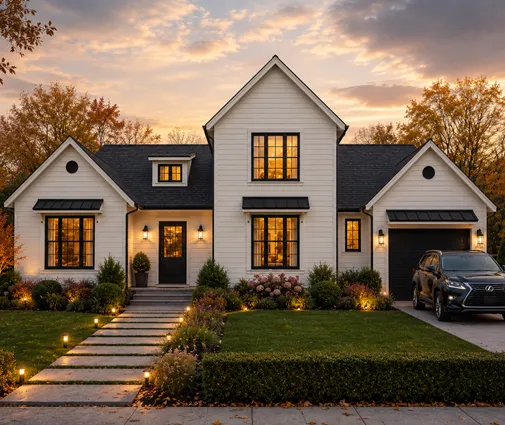
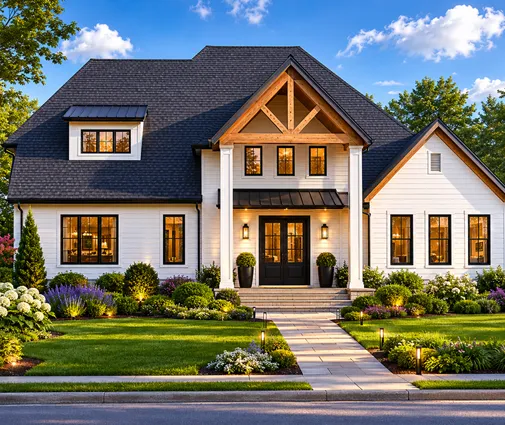
Fact: Stock plans show the layout, structure and often a spot for the mechanical room. The actual heating design is done locally, by your HVAC contractor or a mechanical designer. They work from the energy code your city or county has adopted, typically based on the IRC and IECC with local amendments, and from the orientation and insulation choices for your lot. What the plan does influence is the load. A compact shape like this 2,170 sq ft four-bedroom farmhouse on two stories has less exterior wall per square foot than a sprawling ranch. A 2x6 wall with good air sealing, a well-insulated basement and fewer large north-facing windows make a heat pump easier to size. Before final drawings, make sure there is room for a properly sized air handler and good duct runs, and a clear route for the line set to the outdoor unit. If you want gas, also plan where the flue will exit.
So which one should you choose?
In southern Ohio and the milder parts of Michigan, a good cold-climate heat pump with modest strip backup can heat a tight new house comfortably, and all-electric is a realistic choice. In Minnesota, the Upper Peninsula and other places where -10°F is routine, dual-fuel is usually the safer bet on operating cost, unless your utility offers a strong electric heating rate or gas isn't available on your road. In either case, insist on a Manual J, compare equipment by its 5°F capacity, and run the numbers with your own utility rates. Federal and state incentives for heat pumps have changed recently, so check what applies the year you build with your utility, state energy office or tax advisor.