The most expensive fireplace mistake happens before anyone picks a unit. It happens when the plan is finalized with a box on the great room wall labeled "FP" and nobody decides what that box is. A direct-vent gas unit, a wood-burning fireplace and a linear electric model need very different framing, venting, roof work and electrical or gas runs. Choose late, and you pay for change orders, a chase that was never drawn, or a roof penetration in the wrong place.
This comparison covers what each option adds to the build price, what it costs to run each month, which code rules shape the design, and how each one behaves in a tight, energy-code-compliant house. The prices are typical 2025 ranges for new construction in the United States; your builder's bid and your region will move them, so treat them as a starting point, not a quote.
The three options side by side
| Criterion | Direct-vent gas | Wood-burning (masonry or factory-built) | Linear electric |
|---|---|---|---|
| Typical installed cost in new construction (2025) | $3,500 to $9,000 | Factory-built: $5,000 to $15,000; masonry: $12,000 to $30,000+ | $1,200 to $5,000 |
| Chase or chimney | Usually none; vents through the wall or a short chase | Full chimney or framed chase above the roofline | None |
| Utilities needed | Gas line (natural gas or propane), often a 120V outlet | Outdoor combustion air, no utilities | Dedicated 120V or 240V circuit |
| Heat output | Real supplemental heat, often 20,000 to 40,000 BTU/h | Open masonry fireplace: little net heat; high-efficiency factory units: much better | About 5,000 BTU/h (1,500 W) at most |
| Running cost per hour (2025) | Roughly $0.30 to $0.70 natural gas; $0.80 to $1.30 propane | Firewood at $200 to $500 a cord, region dependent | About $0.20 to $0.40 with heat, pennies for flame only |
| Annual upkeep | Service check, about $100 to $250 | Chimney inspection and sweep, about $150 to $400 | Almost none |
| Effect on a tight house | Sealed combustion, works well | Needs outdoor air and tight doors; risk of drafts and backdrafting | No effect on the envelope |
| TV above it | Possible with heat-management models and proper clearances | Usually a poor idea | Easiest |
Upfront cost: what the fireplace adds to the build
The sticker price of the unit is the smaller part of the bill. For a direct-vent gas fireplace you also pay for the gas line, the vent kit, framing the surround, a noncombustible facing and the mantel or finish. A plain 36-inch unit with a simple surround sits near the bottom of the range; a 60-inch linear unit with tile to the ceiling lands near the top.
A factory-built wood fireplace (often called zero-clearance) is a metal firebox listed to sit close to wood framing, with a listed chimney pipe running up through a framed chase. The chase, its roofing, flashing, siding and chimney cap often cost as much as the firebox. A site-built masonry fireplace needs its own footing, block or brick firebox, a flue liner and a masonry chimney, which is why it sits in a different price bracket.
A linear electric unit is a box in a framed wall with a dedicated circuit behind it. The finish around it is often the biggest line item.
Verdict: electric is cheapest to build, gas is mid-range, and wood costs the most, with masonry at the very top.
Framing, chase and venting
This is where the house plan matters. A direct-vent gas unit draws combustion air from outside and exhausts through a coaxial pipe, usually horizontally through an exterior wall. That means the fireplace generally belongs on an exterior wall, or in a shallow bump-out, and the vent termination must keep the clearances the manufacturer lists from windows, doors, decks and the soffit. Some models can vent vertically through the roof instead, which frees you to put the unit on an interior wall.
A wood fireplace needs a chimney that goes up through every floor and the roof. Under the IRC, a chimney must extend at least 3 feet above where it passes through the roof and at least 2 feet higher than any part of the building within 10 feet. On a two-story house or under a vaulted ceiling that can mean a tall, exposed chase that has to be framed, braced and flashed. In hurricane and high-wind zones, and in seismic areas, the engineer will look closely at that chase and at any masonry chimney.
Electric needs nothing beyond a wall cavity deep enough for the unit, often 6 inches or so for slim linear models, which is why it fits easily into a 2x6 wall or a furred-out media wall.
Verdict: electric is the simplest, gas is easy if planned on an exterior wall, and wood shapes the whole roof and floor plan.

Hearth, clearances and code
Wood-burning fireplaces carry the strictest rules. The IRC requires a noncombustible hearth extension in front of the opening: for an opening under 6 square feet, at least 16 inches in front and 8 inches on each side; larger openings need 20 inches and 12 inches. Combustible trim and mantels must stay a set distance from the opening, and factory-built units must follow their listing exactly. Some air districts, particularly in parts of California and the Mountain West, restrict or ban new wood-burning fireplaces altogether, so check before you design around one.
Gas units follow the manufacturer's installation manual for mantel height, side-wall clearance and hearth requirements, and many need no raised hearth at all. A few jurisdictions have limited new gas hookups in recent years; your city or county building department can tell you what applies to your lot. Electric units follow their listing and the electrical code, with few clearance limits.
Verdict: electric and gas are easy to pass; wood demands the most space and the most homework with the local authority.
Monthly bills and real heat
A gas fireplace is the only one of the three that can meaningfully heat a room. Running a 30,000 BTU/h unit for three hours a night through a winter month adds roughly $30 to $60 on natural gas at 2025 prices, more on propane. Pick a model with electronic ignition rather than a standing pilot, which burns gas around the clock.
An open wood fireplace feels warm in front but pulls heated air from the house up the flue, so the furnace often works harder. High-efficiency factory-built wood units and fireplace inserts change that picture, but cost more. Firewood prices vary widely by region, and if you buy it, a cord rarely costs less than $200.
An electric unit's heater tops out around 1,500 W, enough to take the chill off a room, at about $0.20 to $0.40 an hour depending on your electricity rate. The flame effect alone costs almost nothing, which is why many owners in the South run it year-round without the heater.
Verdict: gas delivers the most heat per dollar, electric is cheapest to run for ambience, and an open wood fireplace is the least efficient.
Living with it in a tight, energy-code house
New homes built to the current energy code are much tighter than older ones, and that changes the fireplace question. The IECC requires new wood-burning fireplaces to have tight-fitting flue dampers or doors and outdoor combustion air. Even so, a wood fire in a tight house can struggle to draft, especially when a powerful range hood or bath fans are running, and smoke can spill into the room. Your builder and HVAC contractor should plan make-up air if the house has both a wood fireplace and a big hood.
Direct-vent gas is sealed from the room, so it does not compete with the house for air and does not affect blower door results the way an open flue can. Electric has no flue and no penetration at all, which makes it the easiest choice in a high-performance or all-electric home.
Verdict: direct-vent gas and electric are made for tight houses; wood needs careful detailing to work.
Great-room layout: fireplace, TV wall and windows
In an open floor plan the fireplace and the TV compete for the same focal wall. There are three common solutions:
- Stacked: the TV above the fireplace. It saves wall space, but the screen often ends up too high for comfortable viewing. With electric, or with gas units designed to redirect heat away from the wall above, it works if the mantel and recess follow the manufacturer's clearances. Above a wood fire, avoid it.
- Side by side: fireplace on the exterior wall between two windows, TV on a perpendicular wall. Seating forms an L that faces both. This suits direct-vent gas, which wants an exterior wall anyway.
- Corner: fireplace angled in a corner, TV on the main wall. It frees up wall space but can eat floor area in smaller rooms.
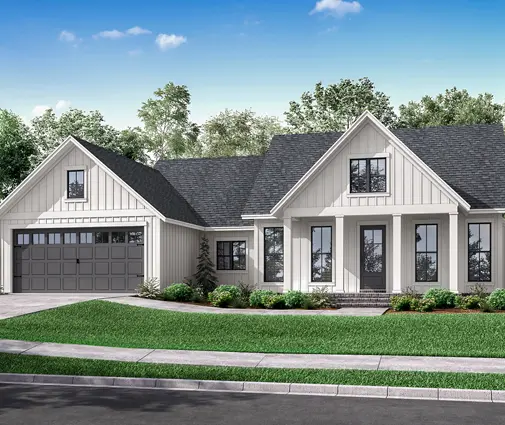
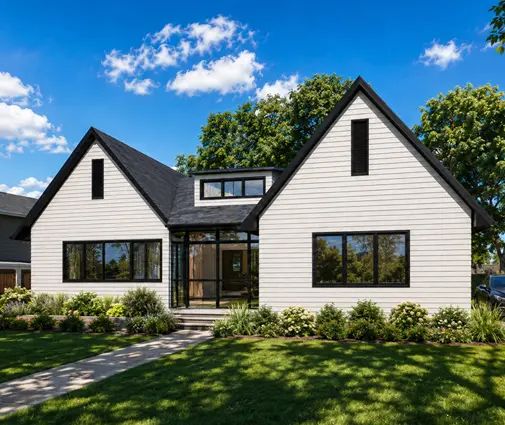
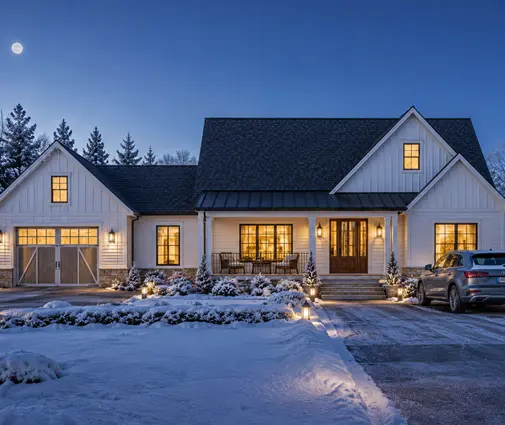
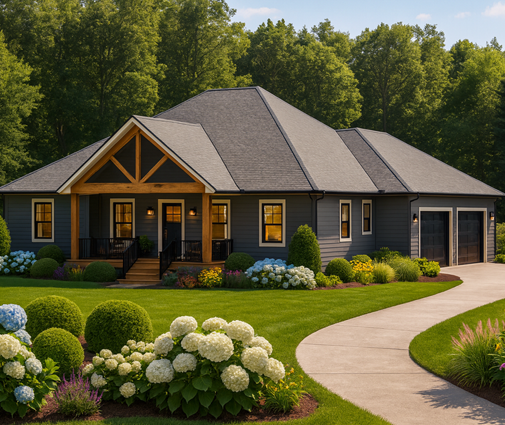
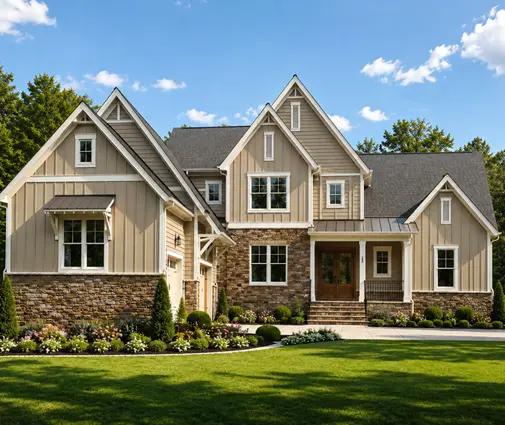
On a compact one-story home such as this 3-bedroom Modern Farmhouse of 1676 sq ft, wall space in the great room is tight, so a slim linear electric unit under the TV keeps windows and furniture flexible. In a 1972 sq ft Craftsman ranch with 3 bedrooms, a direct-vent gas unit on the rear wall, flanked by windows, keeps the roof clean and fits the style. A two-story house like this 3-bedroom Modern Farmhouse of 2150 sq ft is where you would think twice about a wood chimney rising through both floors, while a basement ranch such as this 2489 sq ft plan with 3 bedrooms and a 3-car garage gives room to run a gas line or chimney footing from below.
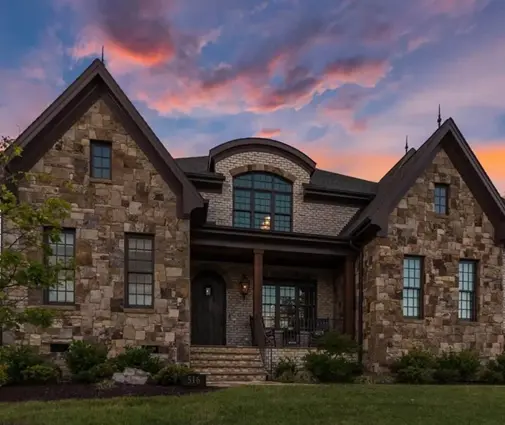
Larger homes can afford a true masonry statement. In this 4343 sq ft Modern Craftsman or this 5204 sq ft Modern Mountain home with 5 bedrooms, a stone wood fireplace can anchor a tall great room, with the TV moved to a separate den or media room. A rustic European design like this 4209 sq ft, 5-bedroom plan can carry a wood fireplace in the main room and a gas or electric unit in the primary suite.

Whatever you choose, have the drafter or engineer adapting your stock plan draw the unit, the vent or chase, and the gas or electrical run before it goes to permit. Moving them later is where the money goes.
Who should choose what
- Choose direct-vent gas if you have natural gas at the lot, live where winters are real, want heat during outages with a battery-free or battery-backup ignition, and can place the unit on an exterior wall.
- Choose a factory-built wood fireplace if you want a real fire on a mid-range budget, have access to affordable firewood, your area allows new wood-burning units, and the plan can take a chase without awkward roof work.
- Choose a masonry wood fireplace if the budget is generous, the great room is large enough to carry it, and the fireplace is meant to be the architectural centerpiece.
- Choose linear electric if you are building in a warm climate, an all-electric home, a tight high-performance house, or want the TV above the firebox at the lowest cost.
- Mix them if you want the best of each: a gas or wood fireplace in the great room and an electric unit in the primary bedroom or bonus room.