Your parents have more land than they need, maybe an acre and a half on a country road or a deep suburban lot with a back half nobody mows. You want to build there, close enough to help with groceries and close enough for the grandkids to run over after school. The land is free, or nearly free, and in a market where a buildable lot can easily cost $60,000 to $150,000 or more in 2025, that is a serious head start. The catch is that a piece of your parents' yard is not a building lot until the county says it is.
Families in many countries make this same move, and looking at how Canada, Germany and Poland handle it shows which steps are universal and which are American quirks. This guide walks through the US process first, compares it with those three countries, and ends with how to choose a compact plan that fits the new, smaller parcel.
Lot split, minor subdivision or ADU: know which path you are on
In the US there are two basic ways to put a second home on family land. The first is to divide the property into two legal parcels, each with its own deed, tax bill and address. Depending on the state and county this is called a lot split, a minor subdivision, a parcel map or a land division. The second is to keep one parcel and add a second dwelling on it, usually as an accessory dwelling unit (ADU), a guest house or a detached in-law home.
When a split makes sense
A split is the right path when you need to own the land under your house. That matters for a mortgage, for resale, and for keeping things clean if your parents later sell, refinance or pass the property to several heirs. Lenders and appraisers are far more comfortable with a house on its own parcel than with a home sitting on someone else's land.
When an ADU is easier
If the lot is too small or too narrow to divide under local zoning, an accessory unit may be allowed even where a split is not. Many states have loosened ADU rules in recent years, and some, California among them, now allow lot splits in single-family zones that used to forbid them. The trade-off is ownership: in most places an ADU cannot be sold separately, and financing a home you do not own the land under is much harder.
What the county checks before approving a split
Every jurisdiction writes its own rules, so treat the points below as the checklist to bring to your planning department, not as the answer.
Minimum lot size and frontage
Zoning sets a minimum area and usually a minimum width or street frontage for each lot. Both the new parcel and the remaining parcel with your parents' house have to meet them. In suburban zones minimum lots often run from about 5,000 to 15,000 sq ft; in rural and agricultural zones the minimum can be one acre, five acres or more. Frontage requirements commonly fall between 50 and 100 feet on a public road, and this is the rule that kills more family splits than any other.
Access to a public road
If the back half of the lot has no frontage, the usual workaround is a flag lot: a narrow strip, often 20 to 30 feet wide, running from the road to the rear parcel. Not every county allows flag lots, and fire codes often require a turnaround or wider drive when a house sits far from the street, commonly when any part of it is more than about 150 feet from the road. A recorded access easement across your parents' land is another option, but lenders will want to see it in writing.
Setbacks around the existing house
Drawing the new line must not push your parents' house, garage or septic field into a setback violation. A survey of everything already on the ground is the first thing to order.
Utilities, surveys and the real cost of a split
The land may be free, but the split is not. Rough ranges for 2025 to 2026 look like this, with wide swings by region:
- Boundary survey and plat: about $2,000 to $10,000, more for large rural tracts or steep ground.
- Application and recording fees: a few hundred dollars to several thousand, plus public notice costs in some counties.
- Attorney and title work for the new deed and any easements: often $1,000 to $3,000.
- Water and sewer taps and impact fees: anywhere from a couple of thousand dollars to $20,000 or more in growing suburbs.
- Septic and well where there is no public service: commonly $10,000 to $30,000 each, and the health department may require a minimum parcel size before it approves either.
Most counties expect each parcel to have its own utility connections and meters once the land is divided. Sharing a well or septic system across a property line is possible in some places with a recorded agreement, but it complicates every future sale.
Taxes and the gift question
Once the split is recorded, each parcel gets its own property tax assessment. If your parents deed the new lot to you, that is a gift for federal tax purposes; above the annual exclusion they file a gift tax return, though actual tax is rarely due because of the lifetime exemption. The less obvious cost is basis: gifted land carries your parents' original cost basis, while inherited land usually gets a stepped-up basis. On land bought decades ago, that difference can matter a lot when you eventually sell. Talk to a tax advisor before the deed is signed, and check whether your state reassesses property on transfer between family members.
How Canada, Germany and Poland handle the same move
The idea of building on a parent's land is the same everywhere. What changes is who approves the split, how strictly road access is enforced, and how kindly the tax system treats a parent handing land to a child.
Canada: severance and committees
Canada looks the most familiar. In Ontario the process is called a severance or consent, granted by a local committee of adjustment or land division committee; other provinces run subdivision approval through municipal or provincial offices. Frontage, lot size and servicing rules work much like American zoning. The notable shift is that several provinces, Ontario in particular, now allow additional units on many serviced residential lots, so a second home without a split is often easier than it used to be.
Germany: surveyor, notary and land registry
In Germany a lot split (Grundstücksteilung) runs through a licensed surveyor and the land survey office, and any transfer of land must be signed before a notary and entered in the land registry. Notary and registry fees are set by schedule rather than negotiated. Two things stand out for an American reader. First, building outside a defined built-up area is heavily restricted, so the "big rural lot" that makes a US family split easy often cannot be built on at all. Second, transfers from parents to children are exempt from the real estate transfer tax, and gift tax allowances between parent and child are generous. Access to a public road must be legally secured, often through an easement registered against the parents' parcel.
Poland: geodesist and municipal decision
Poland's podział działki requires a licensed geodesist to prepare the division map and a decision from the local mayor or municipal head. The new plot needs access to a public road, either directly or through an internal road or easement of a minimum width. Gifts of land to close family are free of gift tax if reported to the tax office on time, and notary fees are capped by regulation. Building on farmland generally requires the land to be designated for housing first, which can add months.
| Step | United States | Canada | Germany | Poland |
|---|---|---|---|---|
| Who approves the split | City or county planning | Municipal committee or province | Surveyor plus land survey office | Mayor or municipal head |
| Notary required | No, deed via attorney or title company | Lawyer handles transfer | Yes, mandatory | Yes, mandatory |
| Road access | Frontage, flag lot or easement | Frontage, rarely flag lots | Legally secured access | Direct, internal road or easement |
| Parent-to-child transfer tax | Gift tax return above exclusion; basis carries over | Varies by province | Transfer tax exempt; large gift allowance | Gift tax exempt if reported |
| Second home without split | ADU rules, widening | Additional units, widening | Possible, often via condominium-style division | Possible if zoning allows |
The takeaway for a US family: American rules are looser on rural land than in most of Europe, but the US tax system is less generous to a parent who gives land to a child. That puts more weight on planning the transfer, not just the split.
Choosing a plan for the smaller parcel
Once you know the new lot lines, subtract the setbacks to get the buildable envelope. A 60-foot-wide lot with 7.5-foot side setbacks leaves 45 feet for the house, and a long flag lot may leave a generous rectangle at the back but a tight path for the driveway. Pick the plan after you draw this box, not before.
Small one-story homes for a parent or a young family
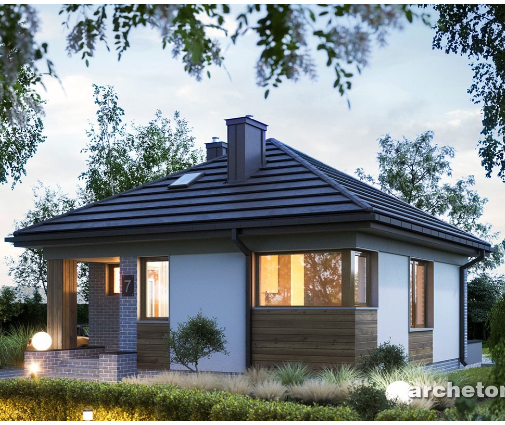
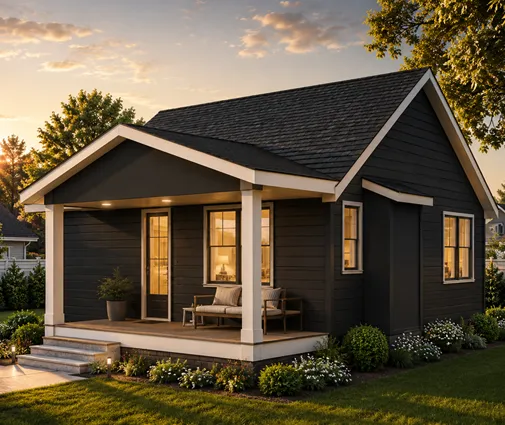
If the new house is for aging parents moving next to you, a single level is the priority. A 713 sq ft cottage with two bedrooms fits behind most existing homes, and the 501 sq ft one-bedroom bungalow is small enough to work as an ADU where a split is not allowed. For a parent who still wants a workshop or room for two cars, look at the ranch that pairs 765 sq ft of living space with a double garage. The 800 to 1,000 sq ft range and plans with an in-law suite are good places to keep searching.

Going up instead of out
When the lot is narrow, a second story keeps the footprint small and leaves yard between the two houses. The two-story cottage at 1,137 sq ft fits three bedrooms over a compact base, and the two-level plan with a two-car garage keeps parking inside the envelope instead of spreading across the lot. Browse narrow lot plans if your buildable width is under about 40 feet.
A full family home on a modest footprint
If you are the one moving next to your parents with kids in tow, you still need three bedrooms. The one-story ranch with three bedrooms and two baths stays under 1,300 sq ft, while the modern farmhouse at 982 sq ft shows how much style a small floor plan can carry. Whatever you choose, check the plan's overall width and depth against your envelope, and have a local engineer or drafter adapt it to your soil, foundation type and code.


Questions to settle before you start
Before paying for a survey, sit down with your parents and agree on a few things: who pays for the split and utilities, whether the lot is a gift or a sale, what happens to the land if either house is sold, and how siblings are treated in the estate. A family agreement written down now prevents far harder conversations later. Then call the planning department, ask for the minimum lot size, frontage and setbacks for your zone, and ask whether a pre-application meeting is available.
FAQ
How long does a lot split take in the US?
A simple administrative split can take a few weeks to a few months. If it needs a public hearing, a variance or health department approval for septic and well, plan on six months or longer.
Can I get a mortgage to build on my parents' land without splitting it?
It is difficult. Most lenders want the borrower to own the land under the house. If a split is not possible, ask lenders about options for ADUs, or consider a home equity loan taken by your parents, with clear agreements in place.
Do I need a separate septic system or well?
Usually yes, once the parcels are separate. Some counties allow shared systems with recorded agreements, but each lot often must show room for its own system before the split is approved.
Is it better for my parents to gift the lot or leave it in their will?
It depends on the land's value, its original cost and your family's plans. Gifting gets you building sooner; inheriting usually brings a stepped-up tax basis. An estate attorney or tax advisor can run the numbers for your situation.