A common mistake on a new build is to pick insulation by the R-value printed on the bag. Two houses with identical R-21 walls and R-49 attics can feel completely different in January, and their utility bills can differ by hundreds of dollars a year. The difference is almost never the label. It is air leakage, gaps, compressed batts and how the material handles moisture. That is why the choice between spray foam, blown cellulose and fiberglass batts is really a choice about installation quality and air sealing, and why the cheapest bid is not always the cheapest house to live in.
Below are the installed costs builders were quoting in 2025 and into 2026 for the materials that actually go into 2x6 walls and attics, followed by what drives the big numbers and where you can save without giving up performance. Prices vary a lot by region, crew availability and job size, so treat them as ranges for budgeting, not as a quote.
Insulation cost items for a new 2x6 house
| Item | R-value per inch (approx.) | Installed cost, 2025 (USD) | Notes |
|---|---|---|---|
| Fiberglass batts, R-19 to R-21, 2x6 walls | R-3.1 to R-3.8 | $1.00 to $2.00 per sq ft of wall | Cheapest; quality depends entirely on the installer |
| Dense-pack cellulose, 2x6 walls | R-3.5 to R-3.8 | $1.50 to $2.75 per sq ft of wall | Blown behind netting; fills around wires and boxes |
| Open-cell spray foam, full 2x6 cavity | R-3.6 to R-3.9 | $2.00 to $3.50 per sq ft of wall | Excellent air seal; similar R-value to cellulose |
| Closed-cell spray foam, 2 to 3 in. in walls | R-6 to R-7 | $2.50 to $5.00 per sq ft of wall | Air barrier and vapor retarder; adds some rigidity |
| "Flash and batt": 1 in. closed-cell plus batt | Combined about R-20 to R-23 | $2.00 to $3.25 per sq ft of wall | Foam seals, batt fills the rest of the cavity |
| Loose-fill cellulose, attic floor to R-49 | R-3.2 to R-3.7 | $1.25 to $2.25 per sq ft of ceiling | About 13 to 15 in. deep after settling |
| Loose-fill fiberglass, attic floor to R-49 | R-2.2 to R-2.9 | $1.25 to $2.25 per sq ft of ceiling | Deeper for the same R-value; does not settle much |
| Open-cell foam at roof deck (unvented attic) | R-3.6 to R-3.9 | $3.50 to $6.50 per sq ft of roof | Brings ducts inside the conditioned space |
| Closed-cell foam at roof deck | R-6 to R-7 | $5.00 to $9.00 per sq ft of roof | Premium option, used where depth is limited |
| Air-sealing package (top plates, penetrations, rim joists) | n/a | $0.50 to $1.50 per sq ft of floor area | Often bundled with batts or cellulose bids |
| Rigid continuous insulation, 1 in. outside sheathing | R-4 to R-6 | $1.50 to $3.00 per sq ft of wall | Cuts thermal bridging through studs |
| Blower door test | n/a | $250 to $600 per test | Required by many jurisdictions; worth doing at rough-in too |
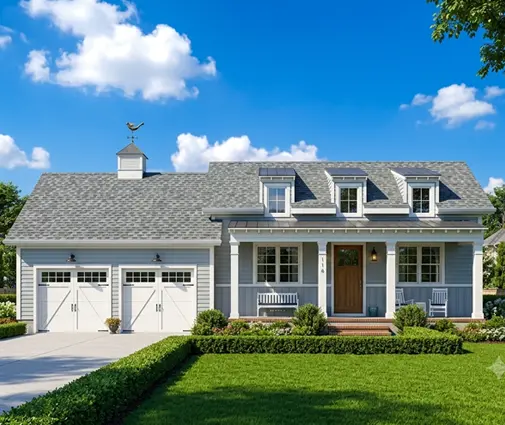
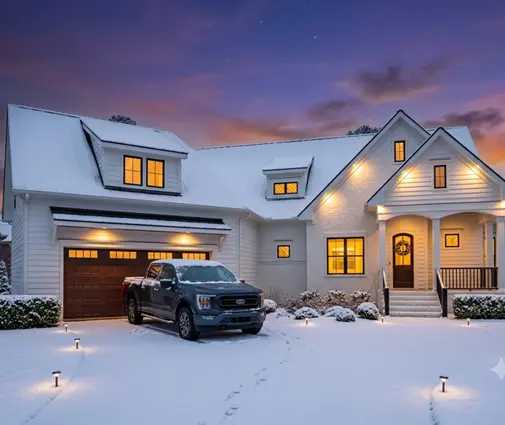
For scale: a one-story house like this 1,953 sq ft three-bedroom modern farmhouse has roughly 2,000 sq ft of attic floor and about 1,500 sq ft of net exterior wall. With batts in the walls, blown cellulose in the attic and a real air-sealing package, insulation lands somewhere around $6,000 to $10,000. Spray foam the walls and the roofline of the same house and the number can climb to $15,000 to $25,000.
The attic: the biggest surface and the easiest win
In a single-story home the ceiling is often the largest insulated surface, so the attic deserves the first look. A sprawling ranch such as this 2,508 sq ft four-bedroom ranch with a 3-car garage has more ceiling than wall, and loose-fill is hard to beat there. Blown cellulose or blown fiberglass to R-49 or R-60 costs little per point of R-value because the attic has room for depth. Current energy codes call for roughly R-38 to R-60 in ceilings depending on climate zone, but the exact number depends on which code edition your state and county adopted, so confirm it with your building department.


Spray foam on the underside of the roof deck makes sense in one main case: when the HVAC equipment and ductwork sit in the attic. In the South, an air handler in a vented attic works in 130 degree air all summer. Moving the insulation to the roofline brings that equipment inside the thermal envelope, and the savings on cooling and duct losses can justify the premium. Open-cell is the usual choice here; in colder zones the IRC sets extra conditions on unvented attics (minimum insulation on the deck, vapor control), so this is a detail for your designer or energy rater, not the foam crew.
Plans with vaulted ceilings need extra thought. A cathedral ceiling leaves no attic for loose-fill, so the roof assembly itself must hold the insulation, usually with foam, high-density batts plus a vent channel, or rigid board above the deck. If you love the look of the vaulted ceiling plans, ask early how the roof will be insulated and price it accordingly.
The walls: why a full cavity of foam rarely pays back
A 2x6 wall holds about 5.5 in. of insulation. Fill it with open-cell foam and you get roughly R-20; fill it with dense-pack cellulose or a high-density batt and you also get roughly R-20 to R-21. The foam's real advantage is air sealing, not R-value. Closed-cell foam reaches higher numbers per inch, but the studs themselves (around R-7 for a 2x6) still bridge heat across the wall every 16 or 24 in., so the whole-wall gain is smaller than the label suggests.
That is why dense-pack cellulose and well-installed batts can match foam on performance when the air sealing is done separately and done well: caulked top and bottom plates, sealed electrical boxes, gasketed drywall or an airtight sheathing layer with taped seams, and sealed rim joists. A blower door test at the rough-in stage, before drywall, shows the leaks while they are still easy to fix.
Batts have the worst reputation mainly because of how they are often installed: compressed behind wiring, cut short around outlets, left with gaps at the top plate. A batt with a 5 percent void loses far more than 5 percent of its effectiveness. Insist on what raters call Grade I installation, which means batts split around wires and pipes, cut tightly around boxes and in full contact with all six sides of the cavity.
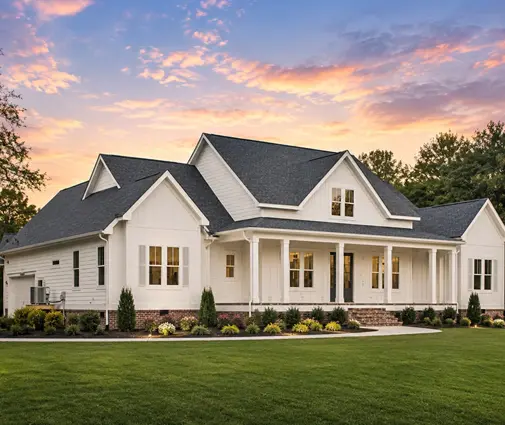
On a two-story home like this 2,488 sq ft modern farmhouse with four bedrooms, the walls run about 2,500 to 3,000 sq ft. Going from batts to full-cavity open-cell foam can add $3,000 to $5,000 there; going to closed-cell can add $5,000 to $9,000. On a larger plan such as this 3,390 sq ft Craftsman farmhouse, those gaps grow proportionally.
Moisture: each material behaves differently
- Fiberglass does not absorb much water, but air moves through it freely, so it depends on a tight drywall or sheathing layer to stop warm, moist indoor air.
- Cellulose is borate-treated and can absorb and release small amounts of moisture, which buffers short wetting events in the wall. Dense-pack also slows air movement.
- Open-cell foam is a good air barrier but lets vapor pass; in cold climates it may need a vapor retarder paint or membrane on the warm side.
- Closed-cell foam acts as a vapor retarder at about 2 in. It can trap moisture if the assembly also has an impermeable layer on the other side, so the wall design must allow drying in at least one direction.
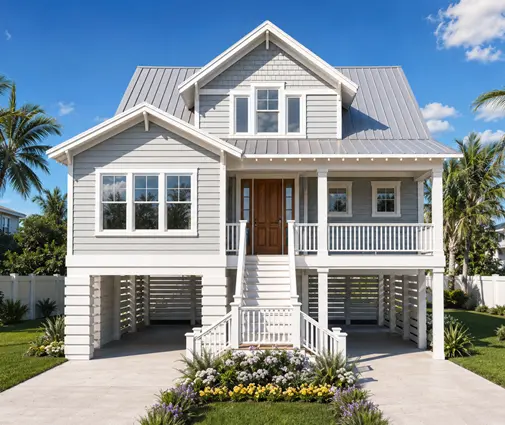
Coastal homes on raised foundations, such as this 2,789 sq ft Low Country beach house with four bedrooms, add another factor: the floor over open air needs the same attention as the walls, and closed-cell foam under the floor deck is common where wind-driven rain and flood vents are part of the picture.

Recommended combinations by climate
Cold climates (Northern states, upper Midwest, mountain areas)
Dense-pack cellulose or Grade I batts in 2x6 walls plus 1 to 2 in. of rigid foam outside the sheathing, which many codes in colder zones now favor or require. Blown cellulose to R-49 or R-60 in the attic. Closed-cell foam at rim joists and on basement walls. A large home with a basement, such as this 6,713 sq ft Tudor-style plan with five bedrooms, has substantial foundation wall area, so budget for it separately. See also the house plans with a basement.
Mixed climates (mid-Atlantic, Ohio and Tennessee valleys, lower Midwest)
Batts or cellulose in the walls with careful air sealing, or flash and batt where you want foam's seal at a lower price. Loose-fill in the attic if the ducts are inside; an unvented open-cell attic if they are not.
Hot climates (Gulf Coast, Florida, Southwest)
Batts or cellulose in 2x6 walls are usually enough on slab-on-grade homes. Spend the money at the roof: open-cell foam at the deck when the HVAC sits in the attic, or keep the equipment inside and blow insulation deep on the attic floor. In hurricane zones, closed-cell foam at the roof deck can add some uplift resistance, but it is not a substitute for proper roof nailing and straps.
How to save without losing performance
- Keep ducts out of the attic. Design changes on paper, such as a dropped soffit or interior chase, cost less than foaming an entire roof.
- Pay for air sealing, not foam. A separate air-sealing line item plus a blower door test often delivers most of what foam promises at a fraction of the price.
- Use foam where it is hardest to beat: rim joists, cantilevered floors, knee walls above a bonus room and tight roof assemblies.
- Choose simpler shapes. A compact plan like this 2,470 sq ft three-bedroom Craftsman has less wall per square foot of living space than a heavily jogged footprint.
- Check rebates. Utilities and state programs sometimes offer incentives for tested, high-performance homes; terms change often, so verify current offers before you sign.
What to ask for in the builder's bid
- The material, thickness and R-value for each surface: walls, attic, roof, rim joists, floors over unconditioned space.
- Whether air sealing is included, and exactly which joints and penetrations it covers.
- Installation grade for batts (Grade I) and target density for dense-pack cellulose.
- A blower door target in ACH50 and who pays to fix the house if it fails.
- For spray foam: product name, thickness and an ignition or thermal barrier where the code requires one.
Summary
- Batts: about $1 to $2 per sq ft of wall; fine when installed to Grade I with separate air sealing.
- Dense-pack cellulose: about $1.50 to $2.75; matches foam's wall R-value and seals better than batts.
- Open-cell foam: about $2 to $3.50 in walls; most valuable at the roofline when ducts live in the attic.
- Closed-cell foam: the premium choice; best for rim joists, tight assemblies and coastal floors.
- Attics: loose-fill cellulose or fiberglass to R-49 or more is the best value per dollar.
- Always: an air-sealing line item, a blower door test and a confirmation of local code levels with your building department.