How many gallons fall on your roof in a year? For most people planning a new house, the honest answer is "no idea," and that is where the myths start. The basic math is simple: one inch of rain on 1,000 sq ft of roof yields about 620 gallons. A typical one-story home in a region with 35 inches of rain a year can collect more water than the family uses on its yard, and sometimes more than it uses indoors. Below are the most common beliefs about rainwater harvesting for a new home, and what actually holds up when you sit down with a plan, a rainfall map and your county's rules.
Myth 1: Collecting rainwater is illegal in most states
Fact: Rainwater harvesting is legal in nearly every state, and several actively encourage it. Texas is the best-known example: rainwater harvesting equipment is exempt from state sales tax, and local governments may offer property tax exemptions and rebates. Colorado sits at the other end because of its water rights system: most single-family homes may collect roof runoff in up to two rain barrels with a combined capacity of 110 gallons, for outdoor use only. Other western states fall somewhere in between, and some cities add their own permits or incentive programs. Rules change, so check with your state water agency, county health department and building department before you size anything, and ask your HOA too, since some covenants restrict visible tanks.
Myth 2: A bigger house collects more water
Fact: What counts is the roof's footprint, not the living area. Rain falls vertically, so the catchment is the horizontal projection of the roof, including covered porches, the garage and the overhangs. A steeper pitch does not add a single gallon. That is why a two-story house of 2,600 sq ft may catch less than a one-story plan of the same size: the second floor stacks living space under the same roof. A wide single-level design such as this 2,508 sq ft four-bedroom Modern Farmhouse ranch with a 3-car garage spreads its roof over the house, the garage and the porch, which can easily add up to well over 3,000 sq ft of catchment. Browse one-story house plans if harvesting is a priority.
To estimate a year's harvest, use this formula:
- Roof footprint (sq ft) x annual rainfall (inches) x 0.62 x efficiency
- Efficiency is usually taken as 0.75 to 0.90, to account for splash, evaporation, overflow and the water you deliberately divert.
- Example: 3,000 sq ft x 30 inches x 0.62 x 0.85 = about 47,000 gallons a year.


Myth 3: Roof shape does not matter
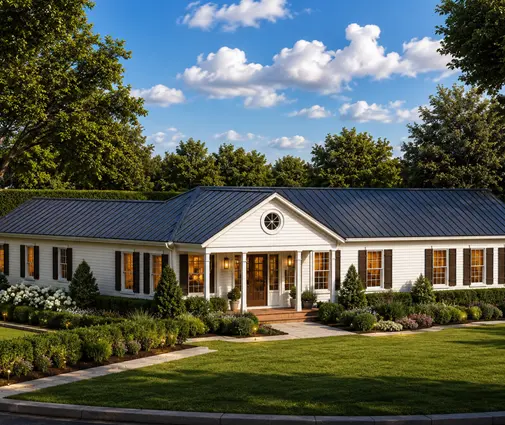
Fact: It matters a lot for cost and for how much water reaches the tank. A simple gable roof drains to two long eaves, so you need two gutter runs and a few downspouts that can be routed to one or two collection points. Hips, valleys, dormers and intersecting ridges multiply gutter runs, corners and downspouts, and every extra joint is a place where water overshoots in a heavy storm. Plans like this 2,600 sq ft four-bedroom Modern Ranch or a traditional 2,565 sq ft ranch with three bedrooms show how a long, straightforward roofline keeps the system simple. The gable roof collection is a good starting point. Material counts as well: standing seam metal is the preferred surface for drinking water, while asphalt shingles are generally fine for irrigation and toilet flushing.
Myth 4: The cistern should hold a whole year's rain
Fact: You size storage for your demand and your longest dry spell, not for the annual total. Start with what the water will do:
- Irrigation only: estimate the weekly garden need during summer and multiply by the number of dry weeks you want to cover.
- Toilets and laundry: these often account for roughly a third of indoor use, a steady demand that a moderate tank, often in the 1,500 to 5,000 gallon range for a family, can cover in a wet climate.
- Whole-house supply: multiply daily use (many families fall somewhere around 50 to 100 gallons per person per day) by the longest typical drought in your area, often 60 to 120 days.
In much of the Southeast, rain arrives year-round and a smaller tank refills often. In central Texas or the Southwest, rain comes in bursts, so storage has to bridge long gaps. As of 2025, above-ground polyethylene tanks typically ran somewhere around $0.50 to $1.50 per gallon of capacity before installation, with fiberglass, steel and buried concrete cisterns costing more.
Myth 5: Rainwater is clean enough to drink straight from the tank
Fact: Rain itself is fairly clean, but the roof is not. Leaves, bird droppings, pollen and dust ride along with the first runoff of every storm. A potable system typically includes:
- Gutter guards and leaf screens on every downspout.
- A first-flush diverter that sends the dirtiest initial runoff away from the tank.
- A calm inlet and a floating intake, so water is drawn from just below the surface.
- Sediment and carbon filters after the pump.
- Disinfection, most often UV, sometimes with chlorination.
- Regular water testing.
Many jurisdictions require a permit, a licensed plumber and health department approval for drinking water from a cistern. A complete whole-house potable setup commonly costs in the tens of thousands of dollars installed, so get local quotes before you commit.
Myth 6: A cistern cannot replace a well
Fact: In places with decent rainfall and poor groundwater, rainwater is the primary supply for many rural homes, especially in parts of Texas and other areas where wells are deep, salty or expensive to drill. A cistern is also an excellent partner for a weak well. A low-yield well that delivers only a gallon or two per minute can trickle into a storage tank around the clock, while the roof tops it up in every storm, and the house draws from the tank at full pressure. Lenders and appraisers in some areas may want to see a reliable water source documented, so talk to your lender early if rainwater will be your only supply.
Myth 7: You can always add rainwater harvesting later
Fact: You can add a barrel later. A real system is far cheaper to design in. Decide during the plan stage where the tank goes, how downspouts reach it, and whether toilets get a separate supply line, often purple pipe under the plumbing code, with backflow protection from the city main. On a slab foundation, typical in the South, pipes to toilets have to be laid before the pour. A compact Southern plan such as this 1,879 sq ft three-bedroom Acadian with a 2-car garage keeps baths close together, which shortens a dual plumbing run. In the North and Midwest, a basement can house the pump and filters; this 2,109 sq ft four-bedroom Craftsman with a basement gives that equipment a frost-free home. Your local engineer or drafter can adapt a stock plan to show the tank, overflow and dedicated lines on the permit set.



Myth 8: Small houses are not worth the effort
Fact: A modest home still collects a lot. This 1,706 sq ft three-bedroom farmhouse ranch with an attached 2-car garage has a roof footprint well above its living area. At 40 inches of rain, even 2,200 sq ft of catchment yields roughly 46,000 gallons in a typical year before losses, plenty for irrigation and toilets for a family of four. Simple ranch-style plans combine a compact budget with a roof that drains cleanly to two sides.
The bottom line
Rainwater harvesting starts with the plan, not the tank. Take the roof footprint, including the garage and porches, multiply by your local rainfall and 0.62, and trim for losses. Then size storage for your use and your driest stretch, not for the whole year. Check your state's rules, from Texas incentives to Colorado's two-barrel limit, and your county's permit and health requirements before you buy equipment. If you are choosing a house plan now, a wide one-story layout with a simple gable roof will give you the most water for the least gutter, and the time to route pipes and place the cistern is before the foundation goes in.