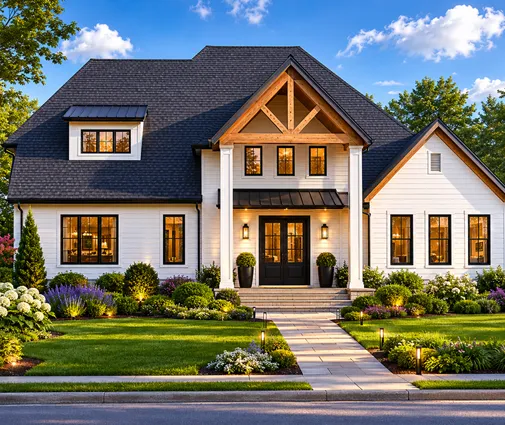
Many buyers spend months comparing plans and bids, then discover the bills that come after closing: the tax statement, the insurance renewal and the utility bills. Over 30 years, those costs can add up to more than the house cost to build. Looking at how other countries handle them is a useful way to see which of them American owners can control and which they cannot.
Below we compare a new 1,300 to 1,700 sq ft family home with a heat pump in the United States, Canada, Germany and Poland. All figures are rough 2025 ranges, converted to USD at approximate 2025 exchange rates. Your county, utility and insurer will give you the real numbers.
Myth: Energy is the biggest yearly cost of a new house
Fact: In much of the US, energy is not the biggest cost. A new home built to a recent IRC energy code, with 2x6 walls and a heat pump, often costs $1,500 to $2,500 a year in electricity, depending on climate and rates. Property tax and homeowners insurance together are frequently two to four times that. The ranking is different in Germany and Poland. There, the tax on a family home is small and insurance is modest, so electricity for the heat pump and the household becomes the largest line. For an American owner, improving the energy design is still worth it, but it addresses only part of the yearly cost.
Myth: Property tax is roughly the same everywhere
Fact: It varies more than any other cost, both between countries and within the US. Effective rates across American states range from well under 0.5% to above 2% of value a year. On a $400,000 new home, that works out to anywhere from about $2,000 to over $8,000. Canadian municipalities charge a similar kind of tax based on assessed value, often 0.5% to 1.5%. Home values in many Canadian metros are high, though, so the bill is comparable to the US. Germany's Grundsteuer was recalculated starting in 2025. For a typical family home it usually comes to a few hundred euros a year. In Poland the tax on a house is based on its floor area rather than its value. For a 1,500 sq ft home it is often under $100 a year. The practical lesson for the US: before you buy a lot, look up the millage rate and any special assessment districts. Two lots a few miles apart, in different counties, can differ by thousands of dollars a year.
| Yearly cost, about 1,600 sq ft, heat pump, 2025 | United States (mid-tax state) | Canada (Ontario suburb) | Germany | Poland |
|---|---|---|---|---|
| Property tax | $3,000–$6,000 | CAD 4,500–7,000 | €300–€900 | PLN 200–500 |
| Home insurance | $1,500–$3,000 | CAD 1,600–2,500 | €400–€900 | PLN 600–1,500 |
| Electricity (heat pump + household) | $1,500–$2,500 | CAD 2,000–3,000 | €1,500–€2,500 | PLN 4,000–7,000 |
| Water, sewer and trash | $1,000–$1,800 | CAD 1,000–1,500 | €800–€1,400 | PLN 1,800–3,500 |
| HOA | $0–$3,600 | usually none | none | none |
| Total, approx. USD | $7,000–$17,000 | $6,500–$10,000 | $3,300–$6,300 | $1,700–$3,400 |
Myth: A bigger house costs more to build but not much more to own
Fact: In the US, almost every recurring bill grows with size. Assessors value larger homes higher. Insurers price the dwelling coverage on replacement cost, which also follows square footage. Heating and cooling loads rise with floor area and wall surface. In Poland, where tax is charged per square meter, a larger house also pays more, but the amounts are small. A compact plan in the 1,500 to 2,000 sq ft range keeps all three lower for as long as you own the house. For example, this 1,292 sq ft three-bedroom ranch with a one-car garage still has a full family layout. Each 100 sq ft you leave out of the plan reduces your tax, insurance and energy bills every year after that.
Myth: Two-story houses always use less energy than a ranch
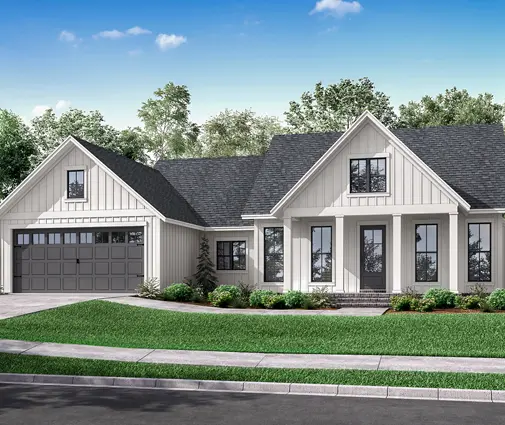
Fact: What matters most is compactness, not the number of floors. A simple two-story box has less roof and foundation per square foot than a sprawling one-story house. That is one reason German and Polish builders favor compact two-level forms. A rectangular two-story Craftsman with three bedrooms in 1,616 sq ft is a good example of this principle. A ranch can also perform well if the footprint is a simple rectangle and the attic is properly insulated. This 1,676 sq ft one-story modern farmhouse keeps its living space under one straightforward roof. Houses spread over three or four levels on a small footprint have more exterior wall per square foot. They are popular on narrow coastal lots, such as this four-level 1,704 sq ft beach home with a two-car garage. If you choose a tall plan like this, plan for extra insulation and careful air sealing.

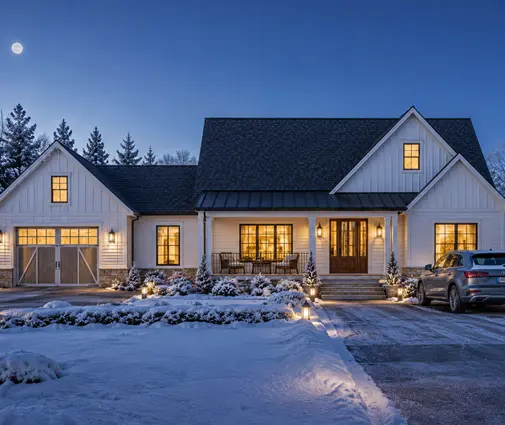
Myth: Europeans have low bills because their energy is cheap
Fact: Their energy is not cheap. In 2025, German household electricity cost roughly twice the average US rate. Polish rates, relative to local incomes, are also high. Yet a new German family home often has an electricity bill similar to an American one. That comes from the building, not the price. German homes typically have thick insulation, triple-pane windows, airtight construction and ventilation with heat recovery. Americans can apply the same approach with 2x6 or thicker walls, continuous exterior insulation, good windows and a blower-door test, without changing the style of the house.
Myth: Solar panels pay back the same way everywhere
Fact: The payback depends on local rules more than on the panels. Where a utility credits exported power generously, rooftop solar pays back faster. Where export credits have been cut, it is better to use the power on site or add a battery. Poland and Germany have also reduced what they pay for exported power in recent years, so European owners now focus on using it themselves. When you choose a plan, look for a large, unshaded roof plane facing roughly south. A simple gable roof like the one on this 1,558 sq ft modern two-story with three bedrooms makes a future array easy to install. Ask your utility about its current net-metering terms before you size a system.
Myth: Insurance is a fixed cost you cannot design around
Fact: Of the four countries, the US has by far the largest regional differences in insurance. In parts of Florida, the Gulf Coast and wildfire areas of the West, premiums have risen far above the national average, and some carriers have stopped writing new policies. Design choices can lower the premium: an impact-rated roof, a hip roof in hurricane zones, wind-mitigation features, ignition-resistant siding, and elevating the house above the flood level in mapped flood zones. In Germany, many owners are encouraged to add coverage for natural hazards such as floods to their building policy, which raises the price. Get insurance quotes for the specific lot before you close on it, not after the house is framed.
Myth: HOA fees are a minor detail
Fact: In many new US subdivisions the HOA fee is a significant yearly cost. It is commonly $100 to $300 a month, sometimes more, and special assessments can be added on top. Detached family homes in Germany and Poland rarely have anything similar. Canadian freehold houses usually do not either, although condo fees are common there. An HOA can also limit your choices: roof materials, solar panel placement, colors and fences. Read the covenants before you choose a plan, because they may rule out some of the energy features described above.


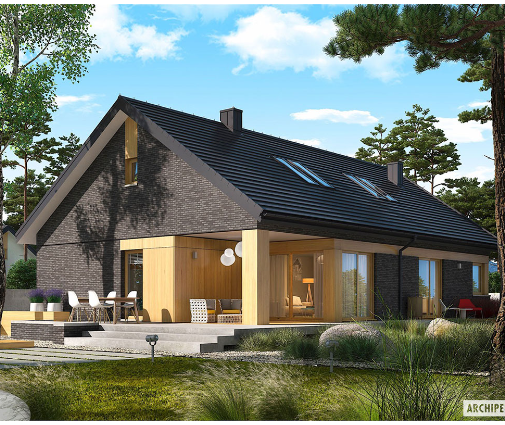
Myth: Running costs are decided after you move in
Fact: Most of them are decided when you choose the lot and the plan. The county sets your tax rate, the flood map affects your insurance, and the shape and envelope of the house set your energy use for decades. An efficient two-story modern plan with three bedrooms in 1,537 sq ft, or a simple one-level home from the one-story collection, gives you a good starting point. A local engineer or drafter can then adapt it to your climate zone and code.
Compared with Germany or Poland, an American owner pays more each year to own a house, mostly because of tax, insurance and HOA fees rather than energy. You cannot change the tax rate, but you can choose where to build, how large the house is, how simple its shape is, and how well it is insulated. Make those choices at the planning stage and confirm the current rules with your county, insurer and utility. A house designed with these costs in mind will be cheaper to own every year you live in it.