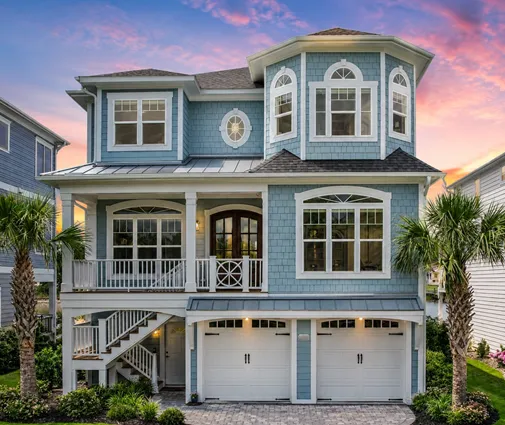
Twenty-odd cents. That is roughly what a kilowatt-hour cost a New Jersey household in 2025, and it is the main reason the short answer is yes: for most new homes with a clear south, southeast or southwest roof, solar panels are worth it in NJ. A typical 7 to 9 kW system pays back in about 9 to 13 years. That assumes no federal tax credit, since the 30% credit for homeowner-owned systems ended after 2025. Net metering at close to the retail rate and the state's fixed solar certificate payments close most of the gap that cloudy winters open. Pennsylvania, Maryland, Massachusetts and Vermont land in different places, and the roof you design matters as much as the state you build in.
The figures below are 2025 to 2026 ranges for a home built from scratch, not a retrofit. Treat them as planning numbers and get real quotes, because rates, incentives and utility rules change every year.
What a rooftop solar system costs on a new house
Installed prices in the Northeast ran about $2.90 to $4.00 per watt in 2025. Adding panels while the house is going up usually lands at the lower end: there is no old roof to work around, the conduit can run inside open walls, and the electrical panel can be sized for solar from day one.
| Cost item | Typical range (2025–2026, 8 kW system) | Notes |
|---|---|---|
| Panels | $6,000–$9,000 | Around 20 modules of 400 W |
| Inverter or microinverters | $2,500–$5,000 | Microinverters cope better with partial snow and shade |
| Racking and roof attachments | $1,500–$3,000 | Higher on steep or metal roofs |
| Labor and installer overhead | $8,000–$12,000 | The largest single line in most quotes |
| Permits, engineering, interconnection | $500–$2,000 | City or county permit plus utility approval |
| Electrical upgrades | $0–$2,500 | Near zero if the plan already calls for a 200 A panel |
| Battery (optional) | $10,000–$16,000 | About 10–13 kWh of storage for backup during outages |
| Total without battery | $24,000–$32,000 |
Are solar panels worth it in NJ, PA, Maryland, Massachusetts and Vermont?
An 8 kW array in this region produces about 9,000 to 10,500 kWh a year. A south-facing roof in southern New Jersey or Maryland makes the most, and a roof in northern Vermont makes the least. What that energy is worth depends on three things: the price of grid power, how your utility credits what you send back, and any certificate or incentive payment on top.
| State | Retail rate, 2025 | Net metering | Certificate or incentive value | Payback, 8 kW, no federal credit |
|---|---|---|---|---|
| New Jersey | About 20–24¢/kWh | Close to full retail | Fixed payment per MWh for 15 years, worth roughly $700–$900 a year | 9–12 years |
| Massachusetts | About 28–32¢/kWh | Close to full retail | A state per-kWh incentive, modest for home systems | 8–11 years |
| Maryland | About 16–19¢/kWh | Close to full retail | Open certificate market, usually a few hundred dollars a year | 11–14 years |
| Pennsylvania | About 17–20¢/kWh | Retail, but rules vary by utility | Weak market, often under $300 a year | 12–16 years |
| Vermont | About 20–23¢/kWh | Credits below retail for newer systems | None of note | 12–16 years |
Are solar panels worth it in Massachusetts? Usually the fastest payback on this list. The state has no meaningful certificate market for homes, but the highest rates in the region do the work. Are solar panels worth it in Maryland? Yes for most owners who expect to stay ten years or more: rates are lower, but full net metering and certificate income keep payback in the low teens. Are solar panels worth it in PA? It is closer. Moderate rates and low certificate prices mean the case is strongest for all-electric homes with high usage. Are solar panels worth it in Vermont? It is often worth it when the panels replace expensive propane or oil heat through a heat pump. On its own, at reduced net metering credits, solar is a slower investment there.
Snow, roof pitch and why a steep two-story roof helps
Snow costs less output than most people expect. In New Jersey or Maryland, a covered array loses a few days a year. In Vermont or the Berkshires, it can lose a couple of weeks. A steeper roof lets snow slide off a dark, smooth panel within hours of a sunny morning. At a 6/12 pitch (about 27 degrees), snow tends to linger. At 9/12 to 12/12 (37 to 45 degrees), it usually clears quickly. A steeper tilt also catches the low winter sun better, which is close to ideal at these latitudes. Leave the eave edge below the array clear, so sliding snow does not pile up against the bottom row, and plan a snow guard above doors and walkways.
Geometry is the other argument. A 12/12 roof has about 40% more surface than the footprint it covers. A two-story house puts the same living space under a smaller footprint, so the roof gets steep without getting huge. On a small lot, a tall, simple gable can hold a full-size array that a low, sprawling roof with many valleys cannot. Fire code access pathways along the ridge and edges take some of that area, so ask the drafter who adapts your plan to show the usable plane early. Browsing two-story house plans with that in mind, and favoring long, uninterrupted gable roof slopes facing south, does more for output than any panel upgrade.
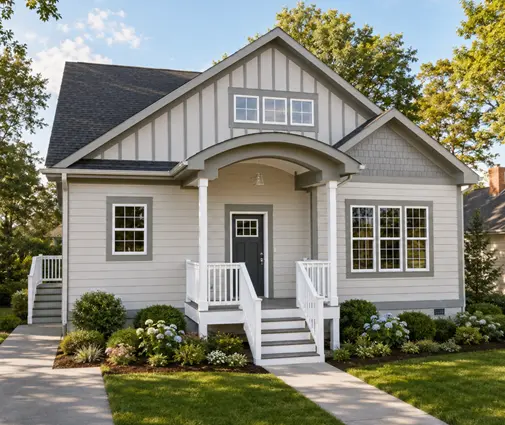
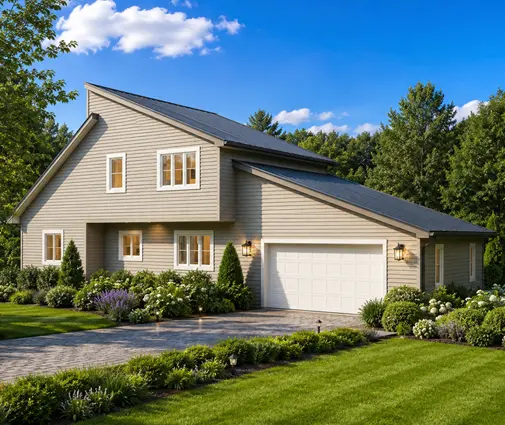
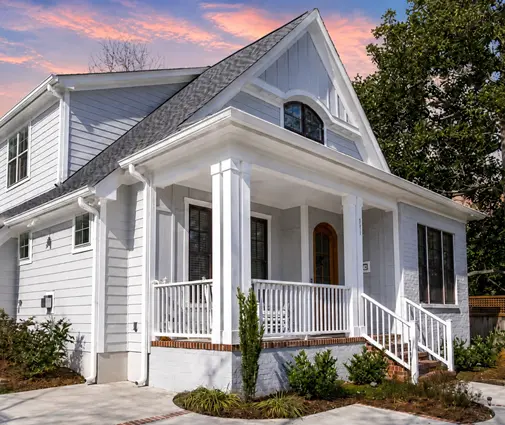
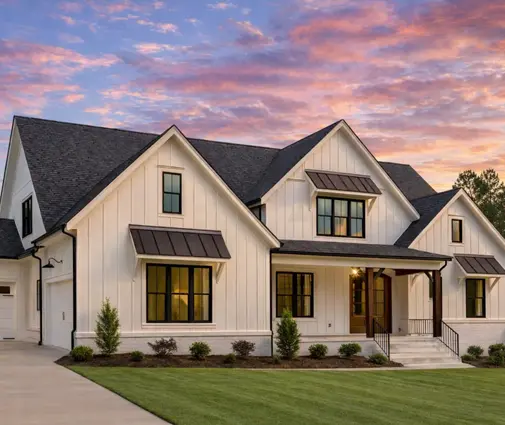
The Craftsman cottage with 1744 sq ft on two floors is a good small-footprint example: one main roof plane can host roughly 6 to 8 kW. The modern two-story plan at 1953 sq ft has clean roof lines with little to interrupt an array. For a growing family, the four-bedroom cottage of 2532 sq ft keeps a compact upper floor under a single broad roof.
Showing it in numbers: a new NJ home with and without solar
Assumptions: a 2,200 sq ft two-story house in central New Jersey, built in 2026 to the current energy code. Electricity costs 22¢/kWh, natural gas $1.40 per therm, and the certificate pays about $85 per MWh for 15 years. Prices are held flat, which is conservative, since rates have risen faster than inflation in recent years. No federal credit, and no battery.
| Scenario | Yearly energy cost | Extra build cost | Savings over 10 years | Savings over 20 years | Payback |
|---|---|---|---|---|---|
| Code-minimum house, gas furnace and water heater, no solar | $2,400–$3,000 | Baseline | – | – | – |
| Same house plus 7 kW solar | $300–$800 net of certificate income | $21,000–$26,000 | $19,000–$25,000 | $36,000–$44,000 | 10–12 years |
| Tighter envelope, cold-climate heat pump, heat-recovery ventilation, 9 kW solar, all-electric | $0–$500 | $30,000–$40,000 | $22,000–$27,000 | $40,000–$50,000 | 12–16 years |
Two caveats. The 20-year column drops the certificate income after year 15. It also leaves out a likely inverter replacement around year 12 to 15, typically $2,000 to $4,000. The all-electric row also skips the gas hookup and monthly gas service charge, often several hundred dollars a year, which the table does not credit.
When a heat pump plus solar makes the most sense
A heat pump moves heat instead of burning fuel. Modern cold-climate units keep working well below 0°F, delivering two to three units of heat for each unit of electricity across a Northeast winter. Paired with solar, the panels cover much of the extra electricity the heat pump uses. The combination pays best in three cases:
- The lot has no natural gas line, so the alternative is propane or heating oil. This is common in rural Pennsylvania, Maryland's western counties and much of Vermont.
- The house is built tight: continuous exterior insulation over 2x6 walls, triple-pane or good double-pane low-e windows, and a blower-door result well below code. That lets a smaller heat pump do the job.
- Your utility credits exported summer power at or near retail, so July surplus pays for January heating.
If you want to go further, the passive house approach takes airtightness and insulation to the point where heating loads drop by roughly 70 to 90% compared with a typical code house. Fresh air then comes from ventilation with heat recovery, which brings in outdoor air while keeping most of the indoor heat. A national Zero Energy Ready certification is a lighter step in the same direction. Most of these states build on a recent edition of the IECC energy code, and Massachusetts lets towns adopt a stricter stretch code. Check which version your town enforces before you finalize the wall sections.
How to save on solar when you build
- Design the roof for it. One large south-facing plane with no dormers, chimneys or vents in the way costs nothing extra on paper and saves real money on racking and labor.
- Run conduit during framing. A chase from attic to electrical panel adds a few hundred dollars and avoids surface conduit later.
- Specify a 200 A panel and a solar-ready roof. Many new homes already get both. Make sure the plan notes them.
- Size to the house, not the roof. Where exports are credited below retail, as in Vermont, a system covering 80 to 100% of use beats an oversized one.
- Cut the load first. Every kWh saved by insulation and tight construction is cheaper than a kWh produced on the roof.
- Get several quotes. Prices per watt for the same system can differ by a third between installers in the same county.
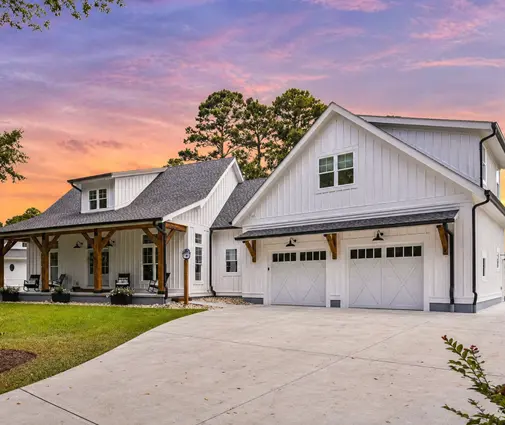
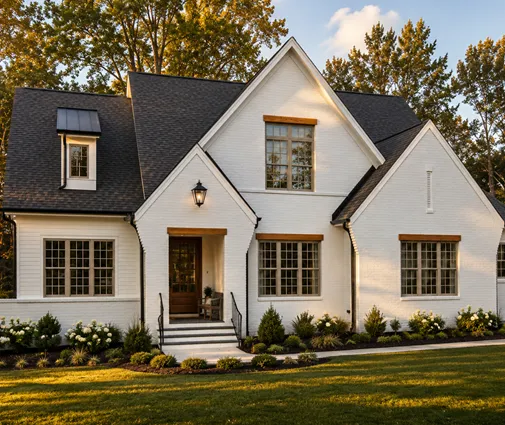
Bigger homes need bigger arrays, but their roofs usually have room. The Modern Farmhouse at 3375 sq ft offers a wide main gable for a 10 to 12 kW system. The four-bedroom farmhouse of 4143 sq ft has enough roof to cover the added load of heat pumps and an electric car. On a tighter budget, the 1695 sq ft cottage that still fits four bedrooms keeps both energy use and array size small.
The short version
- New Jersey: worth it for most new homes, at roughly 9 to 12 years payback, thanks to high rates and fixed certificate income.
- Massachusetts: often the fastest payback in the region, driven by the highest electric rates.
- Maryland: worth it if you stay a decade or longer, at about 11 to 14 years.
- Pennsylvania: closer, about 12 to 16 years, best for all-electric homes with high use.
- Vermont: strongest when solar offsets a heat pump replacing propane or oil.
- Steep, simple, south-facing roofs clear snow faster and hold bigger arrays on small footprints.
- Confirm current net metering, certificate values and code requirements with your utility, your town and a local engineer before you build.
Ready to compare roofs and footprints? Start with these two-story home plans and look for the long, unbroken slope your panels will need.