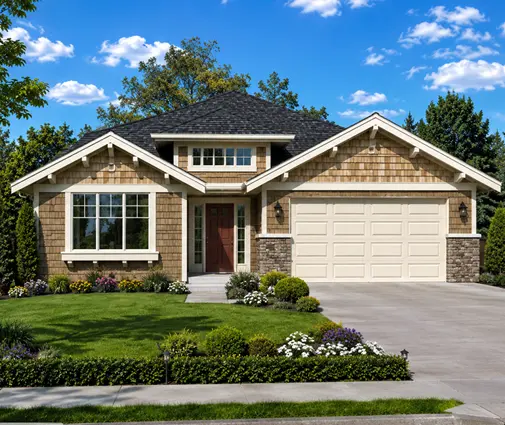
Ten thousand dollars, sometimes thirty. That is the range many American owners discover after the framing is up, when they realize the construction budget covered the house and nothing beyond the front steps. The driveway, the fence, the patio, the drainage swale and the first lawn are real line items, and on a large lot they can cost as much as a kitchen remodel. The garage you pick on the floor plan quietly decides a big share of that number.
Looking at how other countries handle the same work helps. In Germany, Poland and Romania the plot around a new house is planned and paid for very differently, and each comparison points to something an owner in the US can do better. The prices below are rough 2025 ranges. Always confirm current rules with your city or county, your HOA and your builder.
Why the Site Work Gets Forgotten
In the US, a stock house plan shows the house, not the lot. A local engineer or drafter adapts it to your site, and the site plan submitted for the permit shows setbacks, the footprint, the driveway location and grading. But the cost of that driveway often sits outside the builder's base price, or is only covered for a "standard" apron.
What lenders and appraisers expect
A construction loan usually ends with a final inspection and a certificate of occupancy. Many jurisdictions want a usable driveway, final grading and some erosion control before they issue it, and a few require sod or seed in the front yard. When exterior work can't be finished, for example in winter, lenders often hold back part of the funds in an escrow account until it is done. Ask your lender early how they handle that, so the landscaping isn't squeezed out of the loan.
The European habit worth copying
In Poland and Romania, families typically budget the fence, gate and driveway as a separate stage from the first day. In Germany, the local development plan (Bebauungsplan) often dictates what the front yard may look like before anyone buys a plan. The lesson for an American buyer is simple: give the outdoor work its own line in the budget before you pick the plan, not after.
Driveways: Concrete and Asphalt vs Pavers and Gravel
American driveways are poured concrete or asphalt in most suburbs, with pavers as an upgrade and gravel on rural acreage. In Central Europe the default is different: Germans lay concrete pavers called Pflaster, Poles lay kostka brukowa, and on Romanian village homesteads a compacted gravel drive is still common.
| Country | Typical driveway | Rough installed cost, 2025 | Approx. in USD per sq ft |
|---|---|---|---|
| United States | Concrete, asphalt; pavers as upgrade | Concrete $6–15/sq ft, asphalt $3–7/sq ft | $3–15 |
| Germany | Concrete pavers (Pflaster), often permeable | About €60–120 per m² with base | $6–13 |
| Poland | Concrete pavers (kostka brukowa) | About 120–200 zł per m² with base | $3–5 |
| Romania | Gravel in rural areas, pavers in towns | Gravel very roughly 30–80 lei per m²; pavers more | $1–4 |
Exchange rates move, so treat the USD column as a scale, not a quote. The real difference isn't price per square foot, it's labor and climate. European pavers are laid on a deep compacted base by small crews, and a cracked section can be lifted and relaid. In the US, freeze-thaw cycles in the North and Midwest, expansive clay in Texas and heavy trucks during construction all push owners toward a thick slab with control joints. Ask your contractor for 4 inches of concrete as a minimum and more where heavy vehicles will park.
Permeable surfaces
Many German municipalities charge a stormwater fee based on how much of the lot is sealed, so owners pick permeable pavers or gravel strips to lower it. Some American cities have similar impervious-surface limits or stormwater utility fees. If yours does, a paver or gravel driveway may be the difference between passing and failing the lot coverage check.
How the Garage on the Plan Sets the Driveway Bill
This is where the floor plan matters most. The garage position sets the driveway length, and length is money.
- Front-entry attached garage: the driveway runs straight from the street to the doors. On a 25 ft front setback with a 20 ft wide two-car drive, that is about 500 sq ft of paving.
- Side-entry garage: cars need a backing and turning pad, often 25 to 30 ft deep in front of the doors. Total paving can climb to 900 sq ft or more.
- Detached garage at the rear: a 100 ft run plus a turnaround can reach 1,400 sq ft.
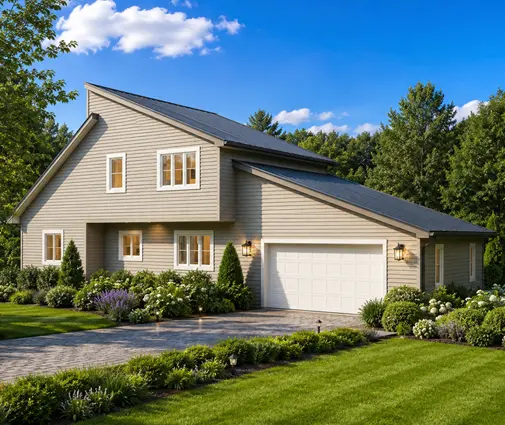
At $8–12 per sq ft for concrete, those three options come out roughly $4,000–6,000, $7,000–11,000 and $11,000–17,000. A compact single-story home such as this 3-bedroom Modern Farmhouse ranch with a 2-car garage at 1993 sq ft keeps the drive short if the garage faces the street. A two-story option like this contemporary 3-bedroom plan of 1953 sq ft with a 2-car garage puts more living space over a smaller footprint, which leaves room on a tight lot for a straight driveway and a usable backyard.

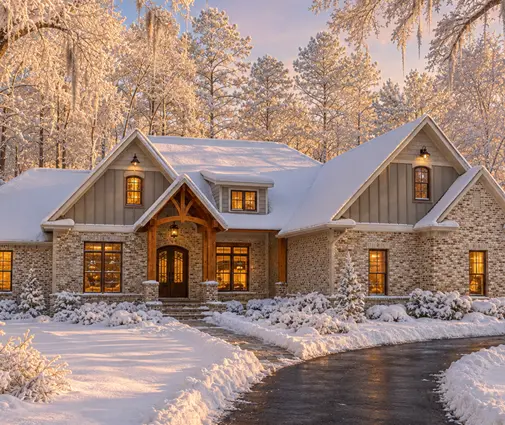
If you're comparing layouts, browse plans with an attached garage and check which way the doors face before you think about the lot. On narrow suburban parcels, plans from the narrow lot collection usually keep the garage up front and the drive short. A family plan like this 4-bedroom Craftsman farmhouse of 2589 sq ft with a 2-car garage is a typical case where flipping the plan to match the side of the lot nearest the street saves real paving.
Fences and Gates: Banned by the HOA, Required in Poland
Here the countries diverge the most.
United States
Many HOAs limit or ban front yard fences, set heights (often around 4 ft in front and 6 ft in back), and specify materials and colors. Cities and counties usually require a fence permit and enforce sight-triangle rules at corners. In 2025, a wood privacy fence typically runs about $20–45 per linear foot installed, vinyl $25–50, and chain link $10–25. Fencing a 100 by 150 ft backyard can easily pass $10,000.
Germany
The Bebauungsplan may restrict fence height in front yards, require a hedge instead, or ban solid walls toward the street. Welded double-wire panel fences are common, very roughly €60–150 per meter installed.
Poland and Romania
An unfenced house is unusual in both. Polish families build a panel or masonry-and-metal fence with a sliding gate, roughly 150–300 zł per meter for a basic panel fence, and an automatic gate adds several thousand złoty. In Romania a fence with a masonry plinth and metal panels is the norm, and it usually needs approval from the local town hall. The gate is sized for a car, so the driveway and fence are designed together.
The takeaway for an American owner: if a fence matters to you, for a dog, a pool or small kids, read the HOA covenants before you buy the lot, not after you've ordered the plan.
Drainage and Rainwater
Water is the one item that cannot wait. In the US, the site plan normally shows finished grades, and the IRC expects the ground to slope away from the foundation, commonly at least 6 inches over the first 10 ft. Downspouts should discharge well away from the house, and many jurisdictions don't allow you to send runoff onto a neighbor's lot. On slab-on-grade homes in the South, a poorly graded yard puts water against the slab. On basement homes in the North, it ends up in the basement.
Poland and Germany are stricter in one respect: rainwater is often expected to stay on the plot, through soakaways, retention tanks or permeable paving. A few US cities now require on-site retention for new homes too. Budget for gutters, downspout extensions, a French drain where the soil is heavy (often $20–50 per linear foot) and, if required, a dry well. Have this priced before closing.
Patio, Lawn and the First Trees: What Can Wait
Not everything has to be finished on moving day. A practical order looks like this:
- Before the permit: driveway location and curb cut, final grades, drainage, any required fence or retaining wall.
- Before move-in: the driveway itself, the walkway to the front door, erosion control, and seed or sod where the city requires it.
- The first year: the patio or deck, the backyard lawn, the fence if it isn't required.
- Later: the outdoor kitchen, garden beds and larger trees.
In 2025, sod usually runs about $1–2.50 per sq ft installed, seeding much less. A concrete patio costs about $8–15 per sq ft and a composite deck often $30–60 per sq ft or more. A small nursery tree planted by a landscaper can be $150–500. Romanian and Polish families often plant fruit trees and a vegetable garden in the first season, before any lawn. That's a good habit wherever you build, since trees take years and grass takes weeks.
A one-story layout with the living area toward the backyard makes a patio easy to add later. This 3-bedroom ranch of 2701 sq ft with a 2-car garage and this 3-bedroom farmhouse of 1676 sq ft with a 1-car garage are examples where a simple rectangular footprint keeps the patio slab and roofline easy to extend.
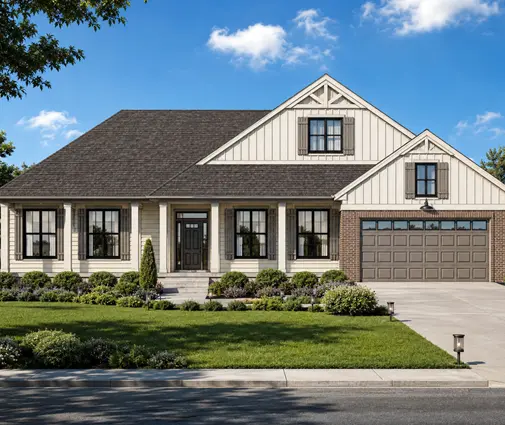
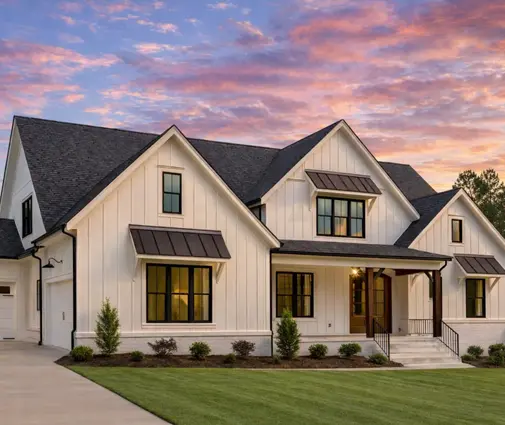
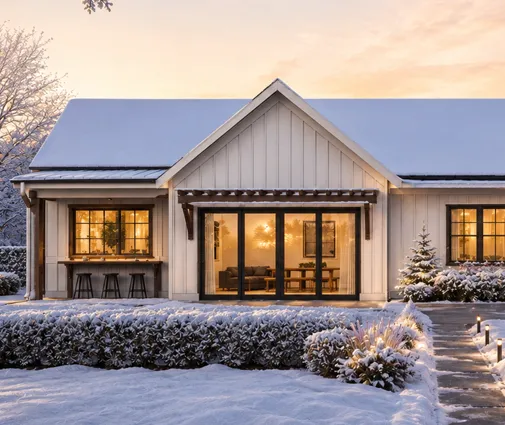
Bigger homes need bigger yards and longer drives. A plan like this 4-bedroom Modern Craftsman of 4160 sq ft with a 3-car garage means a wide apron, often 30 ft or more, before the lawn begins. At the other end, this 1-bedroom Modern Ranch of 982 sq ft with a 1-car garage needs only a short single-lane drive, which suits a backyard cottage or a downsizing project. If you're between sizes, compare the 2-car garage plans first: the extra bay of a 3-car garage often costs more in paving than people expect.
FAQ
Is the driveway usually included in a new home construction price?
Sometimes only a basic apron, sometimes nothing. Ask the builder in writing what length, width, thickness and material are included, and whether the curb cut and permit are in the price.
Do I need a permit for a fence in the US?
In many cities and counties, yes, plus HOA approval if you have one. Height, material and setbacks from sidewalks and corners are the usual limits. Check before ordering the fence.
Are pavers worth it compared to concrete?
They cost more up front in most of the US, but they can be repaired section by section and may count as permeable where stormwater rules apply. In cold climates, a proper compacted base matters more than the material on top.
How much should I budget for the outside of a new house?
On a typical suburban lot, plan for a five-figure sum: driveway, walkway, grading, drainage and a basic lawn first, then the fence and patio. A rear or side-entry garage and a large lot push it higher.