The most common mistake future homeowners make is crossing new construction off the list because they don't have 20% to put down. That figure comes from conventional construction loans, and many local banks still ask for it. Government-backed construction-to-permanent loans work differently. A VA loan can finance the land and the house with nothing down. A USDA loan can do the same in eligible rural areas. An FHA loan asks for 3.5%. The catch is that each program comes with rules about who can build the house, how it is inspected, and how much it must be worth when it is finished. Those rules shape the plan you choose as much as your lot does.
This guide explains how the three programs work, where to find lenders that offer them, and which limits matter when you pick a floor plan.
How a one-time-close construction loan works
A traditional build uses two loans. A short-term construction loan pays the builder in stages. Once the house is finished, you refinance into a permanent mortgage. That means two applications, two sets of closing costs, and the risk that rates or your credit change halfway through.
A one-time-close loan, also called a single-close or construction-to-permanent loan, combines both into a single closing:
- Closing. You close once, before construction starts. The loan pays for the lot, or pays off the land loan if you already own it, and sets up the construction budget.
- Construction phase. The lender releases money to the builder in "draws" as work reaches set stages, such as foundation, framing, dry-in and final. During this phase you usually pay interest only on the amount drawn so far. Some lenders roll those payments into the loan.
- Conversion. When the house passes final inspection and receives its certificate of occupancy, the loan converts to a regular 15- or 30-year mortgage. There is no second closing.
Your rate is usually locked at the first closing. Some lenders offer a "float-down" if rates fall during construction.
The three programs side by side
The table summarizes the main differences as of 2025–2026. Fees, credit minimums and limits change, and individual lenders often add stricter rules ("overlays"), so confirm every figure with the lender you choose.
| VA | FHA | USDA (Guaranteed) | |
|---|---|---|---|
| Who qualifies | Eligible veterans, service members, some surviving spouses | Any qualified borrower | Moderate-income households buying in eligible rural areas |
| Minimum down payment | 0% with full entitlement | 3.5% (credit around 580 and up) | 0% |
| Upfront fee | VA funding fee, about 2.15% on first use with 0% down (waived for many disabled veterans) | Upfront mortgage insurance of 1.75% | Guarantee fee of 1% |
| Ongoing cost | No monthly mortgage insurance | Annual MIP, typically about 0.50–0.55% for most loans | Annual fee of 0.35% |
| Loan limit | No VA cap with full entitlement (lender limits still apply) | County FHA limit | No fixed cap, but limited by income and repayment ability |
| Location rule | Anywhere in the U.S. | Anywhere in the U.S. | USDA-eligible areas only |
| Builder | Licensed builder with a VA builder ID | Licensed builder approved by the lender | Licensed builder meeting USDA and lender standards |
VA construction loans
For eligible borrowers, the VA program is usually the strongest option. Since 2020, borrowers with full entitlement have had no VA loan limit, so in a high-cost county you can finance a larger build with nothing down, as long as you qualify on income and the lender agrees. The VA funding fee can be rolled into the loan. Veterans who receive VA disability compensation are generally exempt from it.
The challenge is finding a lender. Many lenders that make VA purchase loans do not offer VA construction loans. The builder must register with the VA and receive a builder ID, and some builders won't complete the paperwork for a single custom house.
FHA construction loans
FHA one-time-close loans are open to anyone who qualifies, including first-time buyers with average credit. The 3.5% down payment is calculated on the total cost of land and construction. If you already own the lot, the equity in that land can often count toward the down payment. The main drawbacks are mortgage insurance, which for most low-down-payment loans lasts for the life of the loan, and the county loan limit covered below.
USDA single-close loans
The USDA Guaranteed Loan program also allows 0% down, but only for a house in an eligible rural or small-town area, and only if household income is within the limit, generally 115% of the area median income. Many people are surprised by how much counts as "rural." Plenty of fast-growing exurbs on the edge of metro areas qualify. Check the address on the USDA eligibility map before you buy land.
Finding a lender that actually offers these loans
Few lenders offer these loans, and that is the main hurdle with all three programs. Construction lending requires staff to manage draws and inspections, and many big lenders choose not to do it. Here is a practical approach:
- Search for "VA one-time close construction loan," "FHA construction-to-permanent" or "USDA single close" along with your state. A handful of national lenders and some regional banks and credit unions specialize in them.
- Ask local builders which lenders they have closed government construction loans with. A builder who has already finished a VA or USDA build knows the paperwork.
- Ask every lender the same questions: minimum credit score, maximum construction period (often 12 months), how many draws they allow, whether they lock the rate, and how they handle cost overruns.
- Get pre-approved before you sign a contract on land or with a builder.
Builder approval, inspections and warranties
None of these programs is designed for owner-builders. In practice, you need a licensed, insured general contractor who passes the lender's review. That review usually covers years in business, past projects, references, financial statements and sometimes a credit check. For VA loans, the builder also needs a VA builder ID. Allow a few weeks for approval, because it can delay closing.
During construction, the lender sends an inspector before each draw to confirm the work is done. Your city or county building department carries out its own code inspections under the IRC and local amendments. Final conversion requires the certificate of occupancy and usually a final inspection for the loan program. Each program also has warranty requirements. A one-year builder warranty is standard, and some programs or lenders ask for a third-party 10-year structural warranty. Ask your lender exactly what they require before you sign the construction contract.
The appraisal: the house must be worth what it costs
Before closing, an appraiser values the house "subject to completion" using your plans, specifications and the builder's cost breakdown. Comparable sales of recently built homes nearby determine the value. If land plus construction costs $420,000 but the house appraises at $395,000, the loan is based on the lower figure. You then have to cover the $25,000 gap in cash, cut the specifications, or change the plan.
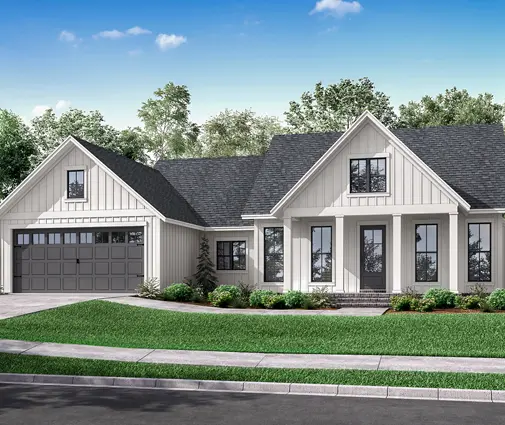
Plan choice matters most here. Upgrades that buyers in your area don't pay for, such as an oversized home theater, a specialty roof or a third garage bay in a starter-home neighborhood, add cost without adding the same amount to the appraisal. A plan that matches what is already selling nearby is the safest bet. In many markets that means a single-story house with three bedrooms and a two-car garage. For example, this 3-bedroom Modern Farmhouse ranch of 1706 sq ft with a 2-car garage is the kind of layout appraisers can easily compare.


How program limits shape the plan you choose
FHA county loan limits
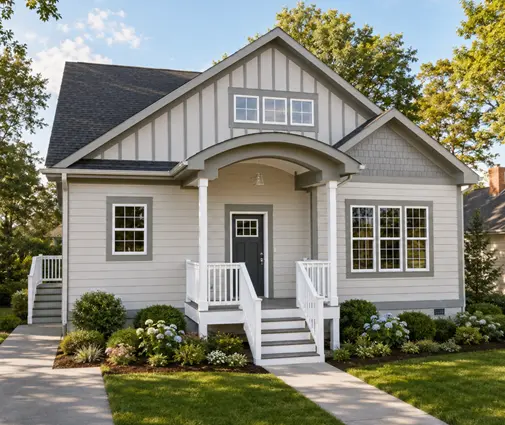
FHA sets a maximum loan amount for each county and updates it every year. For a single-family home in 2025, the limit ranged from $524,225 in lower-cost counties to $1,209,750 in the most expensive ones. Check the current figure on HUD's lookup tool for your county. In a low-limit county where land is not cheap, the cap can decide between a 2,000 sq ft house and a 1,600 sq ft one. If you are close to the limit, a compact two-story plan such as this 1616 sq ft Craftsman with 3 bedrooms and 2.5 baths on two floors reduces the foundation and roof area. Those are two of the most expensive parts of any build.
USDA income and location rules
For a USDA guaranteed loan, the program does not limit the size of the house, but your income does. The household must stay under the area income limit, and your payment has to fit the program's debt-to-income guidelines. That naturally points toward efficient plans in the 1500–2000 sq ft range. A good example is this 1879 sq ft Acadian-style 3-bedroom ranch with a 2-car garage, which suits a typical slab-on-grade lot in the South. USDA guaranteed loans also don't finance income-producing features or in-ground pools, so keep those out of the construction contract.
VA entitlement and residual income
With full entitlement there is no VA cap, but the VA residual income test and the lender's own maximum still limit the budget. If part of your entitlement is already in use on another home, your zero-down amount is tied to the county conforming limit. Ask the lender to calculate this before you choose a plan.
Regional cost drivers
Foundation type can shift the budget by tens of thousands of dollars. In the North and Midwest, a full basement is often expected and helps the appraisal. A plan like this 1906 sq ft single-story Transitional home with a basement fits that market. In the South, slab on grade is the norm, and adding a basement rarely pays back in value. In hurricane and seismic zones, the engineering upgrades your local engineer adds to a stock plan are part of the construction cost. Include them before the appraisal, not after.

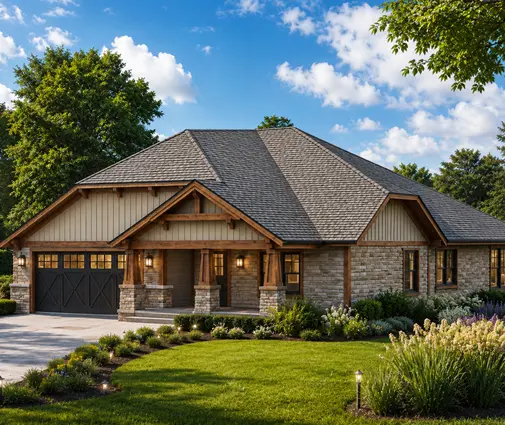
If you are comparing options, start with 3-bedroom house plans and single-story plans. These are the layouts with the deepest pool of comparable sales in most U.S. markets. For a slightly larger family home, this 2007 sq ft Craftsman ranch with 3 bedrooms and a 2-car garage still stays within reach in many counties.
A realistic step-by-step order
- Get pre-approved for the specific program with a lender that offers construction loans.
- Check land eligibility: USDA map, zoning, setbacks, HOA rules, utilities, and soil or septic feasibility.
- Choose a stock plan that fits the lot and your budget, and have a local drafter or engineer adapt it to local code.
- Get a fixed-price bid from a builder who will go through the lender's approval process.
- Submit the plans, specifications and contract for the appraisal, and adjust if it comes in short.
- Close once, obtain the permit from the city or county, and start construction.
FAQ
Can I use land I already own as the down payment?
Often yes. If you own the lot outright, most lenders count its appraised value as equity toward the down payment. This is especially useful for FHA's 3.5% requirement. If there is still a land loan, it is usually paid off at closing.
Can I act as my own general contractor?
Generally no. VA, FHA and USDA construction loans all expect a licensed, approved builder. Owner-builder projects usually need a conventional or portfolio construction loan with a larger down payment.
What happens if construction costs go up mid-build?
Most lenders build a contingency reserve into the budget, often 5% to 10%. Overruns beyond that reserve usually have to be paid in cash, so a fixed-price contract and a fully specified plan before closing protect you best.
Are rates higher than on a regular purchase mortgage?
They are often slightly higher, because fewer lenders offer these loans and the construction phase carries extra risk. Compare at least two or three lenders and ask how the rate lock works over a 9- to 12-month build.