A thunderstorm rolls through on a Friday night. By Monday the framing lumber on your lot is soaked, the coil of copper wire by the slab is gone, and a sheet of OSB has blown into the neighbor's fence. Who pays? Most first-time builders assume "the builder's insurance," and most of the time they are only partly right.
In the United States the gap between "my contractor is insured" and "my house is insured" is filled by a builder's risk policy. Other countries solve the same problem differently, and looking at how they do it shows where American owners tend to leave holes. Here is the checklist, stage by stage.
Stage 1: Before you sign the contract, sort out who carries what
- Builder's risk: the contract says in writing whether you or the general contractor buys it.
- General liability: you have a certificate of insurance from the GC naming you as additional insured.
- Workers' comp: the GC and the major subs carry it, so an injured framer does not become your claim.
- Subcontractors: the GC collects certificates from every trade, not just the big ones.
- Owner-builder: if you act as your own GC, you buy both the property and the liability coverage yourself.
The contractor's liability policy pays for damage the contractor causes to others. It usually does not pay to rebuild your half-finished house after a fire or a windstorm. Canada works much like the US: the policy is called course of construction, and either the owner or the builder buys it. Poland is the case that should worry you. Many owners there rely on the contractor's liability (OC) policy alone and discover too late that it has the same gap. Read the insurance clause of your contract before you sign it.
Stage 2: Before the excavator arrives, bind the builder's risk policy
- Start date: coverage begins before ground is broken, not when framing starts.
- Insured value: the limit equals the full completed construction cost, not the loan amount or the lot price.
- Term: the policy runs at least as long as the realistic schedule, with an extension option.
- Named parties: owner, GC and lender all appear on the policy.
- Premium: you have quotes from more than one carrier or agent.
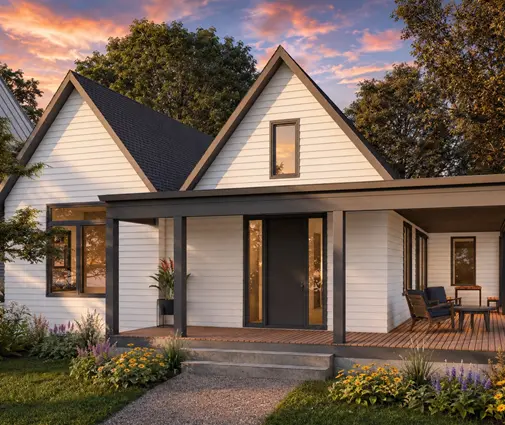
As a rough guide, in 2025 builder's risk for a single-family home often ran from about 1% to 4% of the construction cost for the term, depending on region, construction type and deductible. Treat that as a starting point and get real quotes. Value drives the price. A compact build like this one-bedroom modern ranch under 1,000 sq ft insures for a fraction of what a six-bedroom estate with a full basement does. Germany splits the job in two. The Bauherrenhaftpflicht covers the owner's liability for the site and is cheap. The Bauleistungsversicherung covers damage to the work itself. Fire is often covered separately, sometimes bundled with the future home policy. Americans get all of this in one policy, and that makes it easy to forget that the liability half matters too.
Stage 3: While the walls go up, check theft, weather, flood and quake
- Theft of materials: lumber, appliances and wire stored on site but not yet installed are covered, or you add an endorsement.
- Wind and hail: you know the named-storm deductible, which in coastal states can be a percentage rather than a flat amount.
- Flood: it is excluded by default, and you know whether a separate flood policy can cover a building under construction in your zone.
- Earthquake: it is excluded by default, and you have priced it if you build in a seismic area.
- Site security: you have fencing, lighting or cameras if the policy requires them.
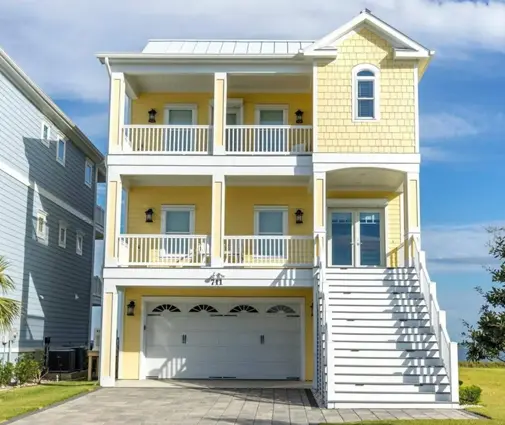
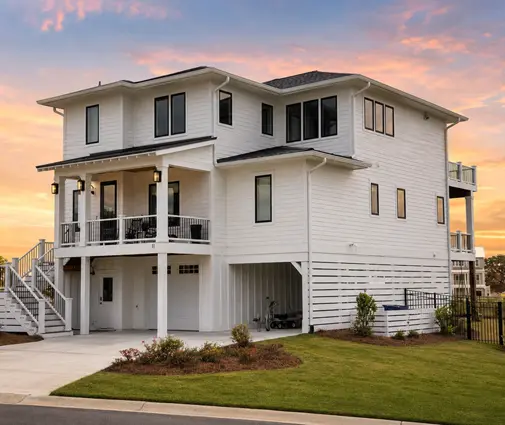
Theft and weather are the claims that actually happen. Coastal builds deserve extra care: a raised, multi-level design like this four-story beach house on pilings sits in exactly the zones where wind deductibles climb and flood coverage is a separate purchase. Browse the beach house plans and you will see how many are elevated for that reason. Romania is a useful lesson here. Its mandatory home policy against earthquake, flood and landslide applies to finished dwellings, so the construction period has to be covered separately. In the US, flood and quake are never automatic either.
Stage 4: Before the first draw, give the lender what it asks for
- Loss payee: the lender is named as mortgagee or loss payee on the builder's risk policy.
- Minimum limits: you have the lender's required liability limits in writing.
- Proof: certificates are delivered before closing on the construction loan, not after.
- Flood determination: if the lot is in a mapped flood zone, flood coverage is in place before the lender funds.
- Renewal: you know who extends the policy if the schedule slips.
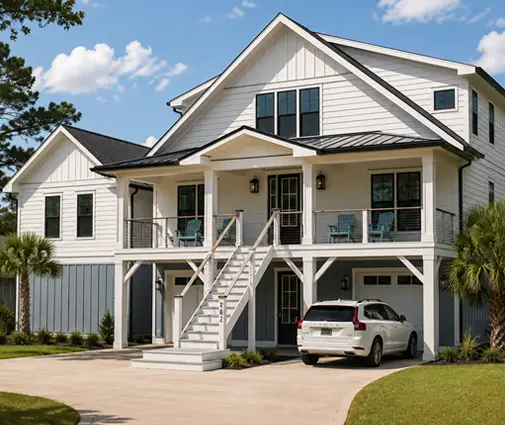
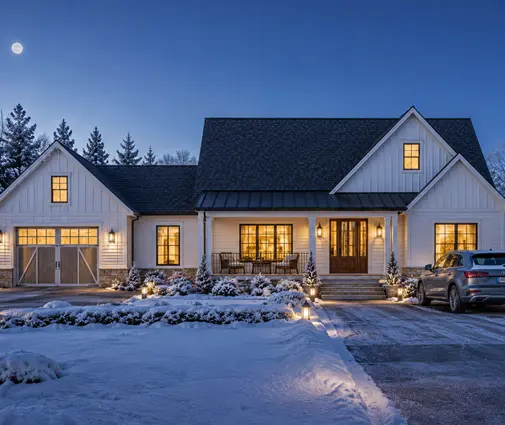
Construction lenders in the US and Canada usually will not release money without builder's risk in place, and the same goes for many lenders in Europe. That pressure is helpful, but the lender protects its loan, not your equity. If you put substantial cash into the build, ask whether the policy limit covers the full cost, not just the loan balance. On a large two-story like this farmhouse with a three-car garage and wide porches, the difference between the loan amount and the real replacement cost can be large.
Stage 5: At the keys, switch to a homeowners policy without a gap
- Trigger: you know whether builder's risk ends at the certificate of occupancy, at move-in or on a fixed date.
- Overlap: the homeowners policy starts the same day builder's risk ends, or a day before.
- Vacancy: a finished house sitting empty for weeks may need special coverage.
- Dwelling limit: the homeowners policy is set at replacement cost, not appraised market value.
- Endorsements: flood, quake, water backup and sewer backup carry over if you need them.
The handover week is when policies quietly lapse. The GC's coverage ends, the homeowners policy has not started, and the movers dent a door frame. Set the homeowners start date as soon as the final inspection is scheduled. Germany handles this more smoothly, because the future building policy often starts during construction and simply continues. If your house has a basement, check sump and backup coverage specifically. The basement house plans common in the North and Midwest are exactly where that endorsement pays for itself. For simpler single-story plans like this split-bedroom ranch just under 2,000 sq ft, the switch is usually painless, as long as someone remembers to make it.


The most common mistakes
- Trusting the contractor's policy to rebuild your house. Liability coverage pays for damage to others, not to your structure.
- Insuring the loan, not the house. Your equity goes uncovered.
- Assuming flood and earthquake are included. They almost never are, in the US or in Romania.
- Leaving materials loose on site without theft coverage or security.
- Letting builder's risk lapse before the homeowners policy starts.
- Skipping liability as an owner-builder, the US equivalent of the German Bauherrenhaftpflicht that many owners never buy.
Rules, required forms and available coverage differ by state and by carrier. Before work starts on any plan, go through this list with an independent insurance agent and with your lender.