Where does your dog go after a walk on a muddy March day? If the answer is "straight across the living room rug," the house was not planned with the dog in mind. That is the norm. Floor plans show bedrooms, closets and garage bays, but almost none show a dog bed, a feeding spot or a place to rinse paws.
Pet owners in other countries face the same problem with different rules. In Germany, owners pay a local tax on each dog. In Poland, the fence goes up before the house does. On suburban lots in Romania, the fence also has to keep stray dogs out. Comparing those places with the US makes clear what an American family should plan for, from HOA fence rules to the garage entry. Here are seven ideas that work well when you build here.
1. Make the garage or back door the dog's front door
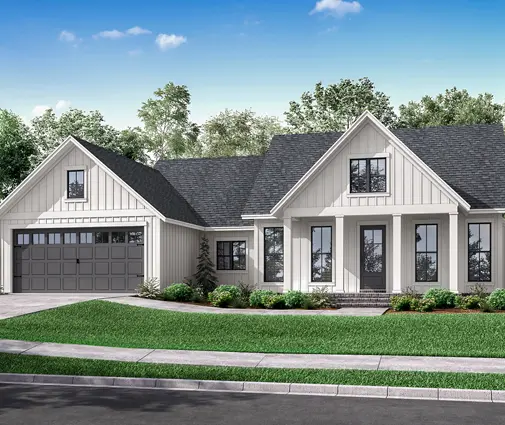
In most American suburbs, the family comes in through the garage, and so does the dog. Plan for that. A garage entry that opens into a mudroom or laundry, rather than straight into the kitchen, gives you a buffer zone for wet coats, leashes and paws. A third garage bay helps too: it can hold a grooming table, a crate or bags of food without crowding the cars. The farmhouse-style ranch with a three-bay garage is a good example of how much room that extra bay leaves for a family whose dog has its own gear. The 3-car garage collection has more.
Germans tend to send the dog through a utility room (the Hauswirtschaftsraum) rather than a garage, because many German homes have a separate garage or carport. Polish and Romanian homes often have a small entry vestibule that serves the same purpose. The idea is the same in every country: dirt stops at one door. In the US, the attached garage is the easiest place to put that door.
2. Add a pet wash station where the dirt comes in
A pet wash station is a raised shower pan, often 36 to 48 inches wide, with a tiled surround, a handheld sprayer and a floor drain. It is one of the most popular pet features in new American homes, and it is far cheaper to rough in during construction than to add later. In 2025, a built-in station in a new home typically cost about $1,500 to $5,000, depending on tile, plumbing runs and whether it is raised to waist height for larger dogs. Put it in the mudroom or laundry, on an exterior wall close to the garage door, and ask your plumber about a hair trap on the drain.
Abroad, the same idea is more often a low shower tray in the utility room or a hose bib and a drain outside the back door. In milder parts of the South, an outdoor rinse station next to the patio can do most of the work, but in snow country an indoor one earns its cost every winter.
3. Choose floors that can handle claws and wet paws
Claws scratch soft hardwood, and urine and water soak into carpet. In the US, luxury vinyl plank has become the default answer for pet owners because it is waterproof, quiet and cheap enough to replace room by room. Porcelain tile is tougher still and works well in mudrooms and in Southern homes on a slab. If you love wood, choose a hard species with a matte finish that hides scratches.
Polish and Romanian homes often use tile on the ground floor anyway, frequently over radiant heating, which dogs like. Germans tend to put tile in the entry and utility room and wood or laminate elsewhere. For an American plan, the useful takeaway is to run the durable flooring continuously from the garage door through the mudroom and into the kitchen, so the dog's main path has no carpet or soft wood on it.


4. Give the bowls and the crate a permanent spot
Water bowls end up in the middle of the kitchen floor because nobody planned a spot for them. Small fixes help: a toe-kick niche at the end of a kitchen island, a cutout in mudroom cabinets for the food bin, or the dead space under a staircase or window seat for a built-in crate. Each takes a few square feet if you mark it on the plan before the cabinets are ordered. Each is hard to retrofit once the cabinets are in.
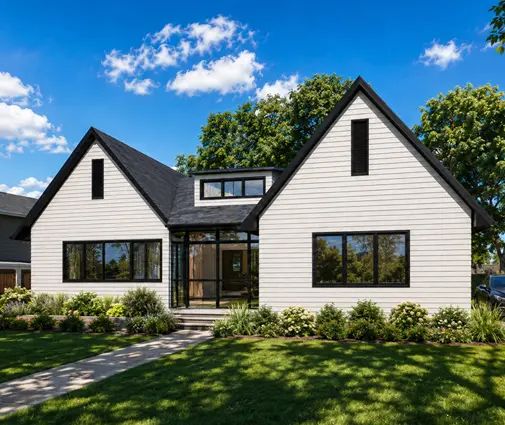
A compact single-story plan like this 1,707 sq ft farmhouse ranch shows that even a modest footprint has room for it. The key is to set the feeding corner near the back door and out of the main path between the kitchen and the dining table. The modern farmhouse with a two-car garage shows another option: a garage entry where a mudroom can hold the food bin, the leash hooks and the crate together.
5. Plan the pet door and the fence together
A pet door is only useful if it opens onto a secure yard. The usual setup is a door into the fenced backyard, close to the dog's sleeping spot. Wall-mounted pet doors installed in new construction ran about $300 to $1,500 in 2025, with insulated and electronic models at the top of that range. A wall unit placed when the house is framed seals better than a flap cut into a patio door later.
The fence is where American and Canadian owners face rules people elsewhere rarely think about. HOA covenants often set the material, color and height of the fence, and some ban solid privacy fences or front-yard fences entirely. Many cities and counties cap backyard fences at around 6 feet and front-yard fences at 3 to 4 feet, and some limit how many dogs or cats a household can keep. Canadian municipalities have similar bylaws. Before you sign a lot contract, read the HOA documents and the local animal ordinance. In 2025, an installed wood privacy fence typically cost about $20 to $45 per linear foot, vinyl about $25 to $60, and chain-link about $10 to $30, so fencing a typical suburban backyard often comes to $4,000 to $12,000.
6. Know what owners elsewhere deal with, and what that means for you
German owners pay a Hundesteuer, a dog tax set by each municipality. It often runs from roughly 100 to 200 euros a year for a first dog, with more for additional dogs and much more for breeds on local lists. Fences there are governed by state neighbor law and local development plans, which often keep them low and open to the street. In Poland, owners usually fence the whole lot early in construction. Fences above a certain height or along a public road generally need a notification to the local office. Neighbors in Lithuania and Latvia work under similar height limits. In Romanian suburbs, owners often build solid fences on a concrete base, because stray dogs can dig under or jump over a simple mesh fence.
The US has no national dog tax, and licensing fees are small. Instead, American owners have to think about wildlife and the climate. In parts of the West and the Southwest, coyotes are a real threat to small dogs and cats, which calls for taller fences, buried wire along the bottom and no gaps under gates. In the Gulf states and on the Atlantic coast, check whether the fence has to meet wind rules. In the North, set posts below the frost line. Your builder or county office can tell you what applies to your lot.
7. Build on one level for the dog's later years
A ten-year-old Labrador with sore hips struggles on stairs, and so do the people who end up carrying it. A single-story plan solves that: the dog's bed, the back door and the yard are all on the same level. Most American ranch and farmhouse plans already work this way, which is one reason they are popular with families that have large or older dogs. Browse the single-story collection with that in mind.
For downsizers with an aging pet, the one-bedroom 765 sq ft cottage has everything on one floor with almost no hallway. Larger families can look at the four-bedroom modern ranch, whose single level makes it easy to keep the dog's spot close to the bedrooms. In the North, a plan with a basement such as this Southern-style ranch still keeps daily life on the main floor, and the basement can be used for storage rather than for the dog. Germans and Poles build more two-story homes on smaller lots, and their older dogs often end up sleeping downstairs alone. With an American lot, you can avoid that.


Conclusion: Plan for the dog when you choose the plan
Other countries show that pet-friendly design depends on local rules: a dog tax in Germany, a fence first in Poland, a fence against strays in Romania. In the US, the rules are set by your HOA and your city or county, the risks are wildlife and weather, and the American plan already has the main advantages: an attached garage, room for a mudroom and the option to live on one level. Choose a plan with those, mark the wash station, the feeding corner and the pet door before framing, and check the fence rules before you buy the lot. Building these in costs much less than adding them later.